
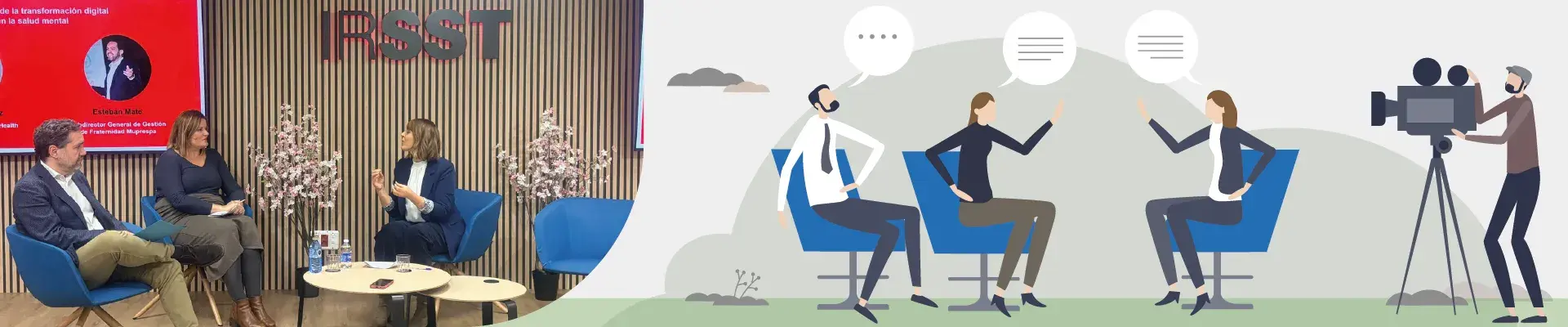
Esteban Mate addresses the challenges of digitalization for occupational mental health at the IRSST
Fraternidad-Muprespa has participated in theInnovation Conferences on Occupational Risk Prevention, organized by the Regional Institute of Safety and Health at Work (IRSST) under the motto“Innovating the prevention of tomorrow today”, a meeting that brought together professionals and experts in Madrid on November 16 and 17 to analyze the main challenges that will mark the future of occupational health and safety.
On behalf of the Mutual,Esteban Mate, Deputy Director General of Management, participated in the panel “The impact of digital transformation on mental health”, next to Anabel Fernandez, CEO&Founder of Afor-Health.
Both experts reflected on the opportunities and benefits that technology brings, as well as the associated risks and challenges it poses for organizations.
During his speech, Mate highlighted that “sick leave related to pathologies in the field of mental health have multifactorial causes. Technology has somewhat accelerated the mental load, although at the same time it is a tool that helps measure and exploit information to improve occupational health.”.
Important representation of the business and institutional world
The day also served to learn about experiences promoted by institutions, companies and entities specialized in prevention. In addition to the representatives of the IRSST, experts linked to the National Institute of Social Security, the Biomechanical Institute of Valencia (IBV) or companies such as Acciona, Elecnor, Iberdrola, CaixaBank or Grupo Santalucía, among others, shared initiatives related to the application of artificial intelligence to prevention, predictive risk analysis, ergonomic adaptation of jobs, the promotion of well-being and mental health or the response to emerging challenges such as climate change.
Likewise, assistance applications for especially risky work and digital tools aimed at improving preventive decision-making in organizations were shown.
These sessions have been conceived as a prelude to the VII Congress on Occupational Risk Prevention of the Community of Madrid, scheduled for next year, coinciding with the 30th anniversary of the creation of the Regional Institute of Safety and Health at Work.