
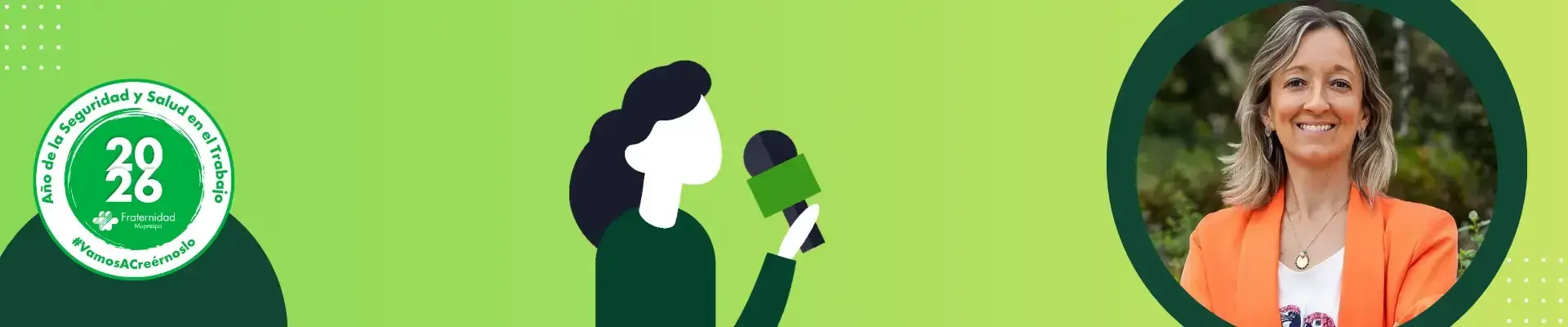
Marina Parra: «The IRSST works to consolidate the preventive culture in the Community of Madrid»
On the occasion of the Year of Safety and Health at Work 2026, Fraternidad-Muprespa continues its series of interviews with professionals and institutions that contribute to the promotion of preventive culture from different areas. On this occasion we spoke with Marina Parra, General Director of Labor of the Community of Madrid and Manager of the Regional Institute of Safety and Health at Work. Graduated in Law and expert in public administration, human resources and public service, she has developed a solid career both in the practice of law and in public management. His experience in labor relations, risk prevention and people management provides a strategic vision of the current challenges of organizations and the role of prevention as a key element to improve people's lives.
2026 has been declared the Year of Safety and Health at Work. What meaning does this declaration have for the Community of Madrid and what opportunities does it open to reinforce the preventive culture in its territory?
This declaration, made to commemorate the 30 years of validity of the Occupational Risk Prevention Law, aims to highlight the importance of carrying out and having adequate preventive management in workplaces, to create safe and healthy work environments for workers. It is a measure aimed at deepening the culture of prevention.
In the Community of Madrid, the Regional Institute of Safety and Health at Work (IRSST) has been working on this line of creating and consolidating a preventive culture since its creation, 29 years ago, from the deep conviction that safety and health at work is the responsibility of all the actors involved (companies, workers, social partners, administrations and public organizations) and, therefore,
The entire society must be aware and well informed about the need to adopt concrete and effective preventive measures
to avoid work accidents and occupational diseases.
From this conviction, the IRSST, in execution of the current Master Plan for the Prevention of Occupational Risks of the Community of Madrid (currently, the VII Master Plan 2025-2028), is reinforcing the actions and resources aimed at consolidating the preventive culture in Madrid society, allocating them not only to companies and work centers and to prevention professionals.
Since 2023, the IRSST has been bringing occupational risk prevention to schools supported by public funds from the Community in their stages of primary education, compulsory secondary education and basic vocational training, in a fun way and adapted to each educational stage through its “Prevention Week” program. This project benefits 50 Madrid schools every year and since 2023, 9,000 students have participated.
We also collaborate with higher vocational training centers, providing specific practical training at the centers' request. And since 2023 we have maintained an important collaboration with Madrid universities, both public and private, through six IRSST R&D&i chairs to promote applied research and the training of university students.
How do you articulate all this prevention training?
We have resources and actions aimed at the work and professional environments of prevention, labor relations and human resources, both through the IRSST Training Catalog and by holding multiple conferences, seminars, conferences and specialized workshops.
Every year an average of 130 free and preferably practical training actions are included in the IRSST Training Catalog
and an average of four high-impact conferences are held for companies on specific subjects of special interest.
We have launched two own training itineraries for ORP technicians: a university expert diploma in new basic professional skills (which deals with aspects such as leadership, effective communication, collective bargaining, among others) and another expert course on accessibility, disability and adaptation of jobs. We try to bring the message of preventive culture also with a general reach to the entire Madrid society, for which we carry out several institutional advertising campaigns annually. We are present on social networks and since 2023 we have organized the Race for the prevention of occupational risks in the Community of Madrid with the aim of extending the message to families, young people and society in general and promoting healthy habits through the practice of physical exercise.
Another important area that we are promoting and constitutes an essential pillar of the IRSST's activity is innovation applied to the prevention of occupational risks, to promote the transfer of knowledge from research areas to companies of all types and sectors, focusing especially on small companies and self-employed workers who lack the necessary resources to apply new and complex tools and procedures.
How do you think the work of mutual societies fits within the preventive system of your community and what improvements or lines of work do you think could be introduced to improve the preventive culture of our mutual members?
The Mutual Collaborators with Social Security constitute a fundamental piece of the Spanish system of protection of safety and health at work, providing technical, assistance and preventive support and thus contributing to the reduction of workplace accidents and the continuous improvement of working conditions. They are a very important pillar in the consolidation of preventive culture through the dissemination of good preventive practices, the development of tools, guides and support materials, providing information on occupational risks and also providing specialized technical advice, both general in nature and specifically aimed at sectors with high accident rates.
They play an essential role in supporting the preventive management of their mutual companies. Taking into account the wide and varied portfolio of services that mutual companies have available to their mutual members, a greater dissemination of these services would probably be advisable, since from the close relationship we maintain with Madrid companies we observe that sometimes they are not aware of the possibility of using all the services that their mutual company makes available. This situation is more common in small companies.
We observe that companies are sometimes not aware of the possibility of using all the services that their Mutual Fund makes available to them.
What assessment do you make of the Strategic Plan for the Prevention of Occupational Risks of the Community of Madrid and its real impact on accidents?
Currently, the IRSST is executing the VII Director Plan for Occupational Risk Prevention of the Community of Madrid 2025-2028, which constitutes our Region's strategy to promote public policies on the matter. To make a complete assessment, I will refer to the execution of the VI Master Plan 2021-2024, which ended with an execution of 92% of the contemplated measures and all of the allocated financing (€55,768,400.00), having met all the contemplated strategic and quality indicators. I especially highlight the 19.3% reduction in the incidence rate for work accidents in the Region compared to the average during the validity of the previous V Master Plan, with the number of work accidents due to occupational diseases having also been reduced.
In relation to the VII Master Plan currently in force, I consider that the balance of the first year executed, 2025, is also positive, since 88% of the planned measures and close to 90% of the assigned budget were executed and most of the strategic indicators have been met; The 8% decrease in the incidence rate of work accidents in the Region compared to the average during the validity of the previous VI Master Plan is especially relevant.
I consider that the balance is positive, but
I know that there is still much to do to reduce workplace accidents to a minimum.
and achieve the real consolidation of the preventive culture in Madrid society, which allows authentic integration of prevention in the companies of our Region. Therefore, at the IRSST we will continue to do our best in the execution of the VII Master Plan in the coming years.
Interview with Elirerto Galván, director of ICASEL
Interview with Pilar Simón, director General of Labor and Occupational Health of La Rioja