Clarifications to the procedure for action of occupational prevention services against Covid
To achieve adequate management by companies of the current _Coronavirus disease outbreak, the health and labor authorities of our country are issuing recommendations and documents with information and help on the matter for companies and workers.
TheMinistry of Health has had the participation of all the national health and preventive reference organizations for the publication of the guide: “Procedure of action for occupational risk prevention services in the face of exposure to the new Coronavirus.” It addresses different issues to be managed by the occupational risk prevention services. companies as the measures necessary to protect workers in this situation, with information on procedures, personal protective equipment, nature of activities and risk assessment.
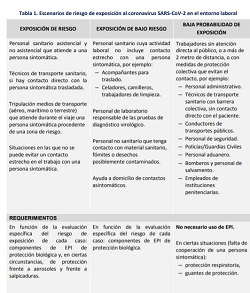
The recommendations included in these documents are under continuous review and may be modified if the epidemiological situation so requires. In this sense, the General Subdirectorate of Environmental Safety and Occupational Health of the Ministry of Health has issued a statement making a series of clarifications to the interpretation of table 1 of the procedure on risk scenarios of exposure to Coronavirus in the work environment.
The procedure states in the second paragraph of its first section: "General issues", and establishes that it is up to companies to evaluate the risk of exposure and follow the recommendations issued by the prevention service on the matter, following the guidelines and recommendations formulated by the authorities. sanitary.
In the section: "Nature of the activities and evaluation of the risk of exposure" it is established that, depending on the nature of the activities and the transmission mechanisms of the Coronavirus, the different risk scenarios in which workers may find themselves can be established, which, for this purpose, are presented in the Table 1.
After the corresponding definitions, which help with the interpretation of the table, three risk scenarios are defined, such as low risk, low probability of exposure. In the first row of the table, examples of workers who meet the definitions to be placed in each risk scenario are provided, and in the second row, the requirements regarding protective equipment are provided. These are, as the document clearly indicates, examples of activities, not an exhaustive list of them.
The National Police can be located in any of the 3 defined scenarios, not permanently and generally, but always depending on the activities it carries out. Thus, for example, the first column reflects that risk exposures will be situations in which close contact at work with a symptomatic person cannot be avoided.Home help for asymptomatic contacts would be considered low-risk exposure (2nd column), and the 3rd column, the low probability of exposure, expressly cites the Police.
The personal protection requirements cited in each column are different, but note that they are preceded by the phrase: “Depending on the specific evaluation of the exposure risk of each case”, the Police personnel may perfectly be placed in any of the 2 exposure columns, depending on the nature of the activities. and assessment of exposure risk, precisely. This evaluation is the only technical activity that can serve as a basis for making preventive technical decisions adapted to each case.
In addition, the 3rd column, of low probability of exposure, whose first recommendation is: “No need to use PPE”, applicable if the heading of the column is met: Workers without direct attention to the public, or more than 2 meters away, or with collective protection measures that avoid contact, is followed by a second recommendation: “In certain situations (lack of cooperation from a symptomatic person), respiratory protection and protective gloves.” The appropriate interpretation of this is that, in general, the Police who are in this scenario should not wear PPE, but must have some PPE components available to be able to use them in certain situations.
The procedure also offers a set of preventive measures of an organizational nature to minimize contact between workers and between the latter and potential clients or the public who may attend their workplace. In this sense, the layout of the workstations, the organization of the circulation of people and the distribution of spaces (furniture, shelves, corridors, etc.), the access control mechanisms at the entrances to the premises, etc., are measures described in the Procedure that can serve as a guide in the tasks that the Police carry out in the Complaints and Citizen Service Offices (ODAC) and in the issuance of ID cards and passports, for example. example.
We consider, in short, that the goodness of the approach adopted in the procedure consists precisely in the possibility of adaptation to each specific case and situation, thus covering multiple scenarios that, if addressed one by one, would prevent us from providing the agile and complete response that the situation requires. requires.
#Stay at home
Fraternidad-Muprespa_has prepared on its web portal Previene_a specific section dedicated to Coronavirus with all the information of interest related to the prevention of occupational risks and health care in the pandemic we are experiencing.
As Mutually Collaborating with Social Security we want to help you in the daily management of the crisis and that is why we offer you all the updated information at the legislative level, as well as the guides action and preventive procedures on COVID-19 from official sources and organizations that may be useful for you to know at this time.
We also propose our: "#StayHomeFM Challenge", since while the confinement lasts we want to offer you information audiovisual to help you continue taking care of your health with three challenges in which we offer you information on psychological well-being, physical exercise and nutrition. Check all the information here.