
Cold stress, how do I protect myself?
Given that we are immersed in the time of year with the highest risk of occupational exposure to cold environments, we will briefly explain what the most frequent adverse effects are and, above all, the measures that we must take to mitigate the risk of cold stress.
According to the Technical Note on the Prevention of Cold Stress of INSST, from temperatures below 15ºC the sensation of thermal discomfort may begin, and below 5ºC the risk should be considered to be immediate.
Cold stress concept
It would be defined as the excessive heat loss to which workers are exposed and that results from the combined effect of physical and climatic factors that affect heat exchange.
Reactions to cold are different depending on each individual, their age, gender, morphology and anthropology, circulatory problems, tiredness, fatigue, consumption of alcoholic beverages or tobacco, lack of food or liquids, inadequate clothing, among others. others...
In the workplace, there are numerous jobs that involve performing tasks in cold environments, due to work carried out outdoors or in industrial areas in sectors such as agriculture, construction, gardening and urban maintenance, street commerce, ski resorts, cold storage rooms or slaughterhouses.
What are the effects of cold exposure on the work?
Working in these conditions can cause frostbite and hypothermia, as well as favor the appearance of diseases such as flu, bronchitis or pneumonia. Likewise, these working conditions can cause accidents, both traffic accidents and falls due to snow and ice formed or the risks of fires and carbon monoxide poisoning from fireplaces, gas stoves or braziers.Let's look at some effects more specifically:
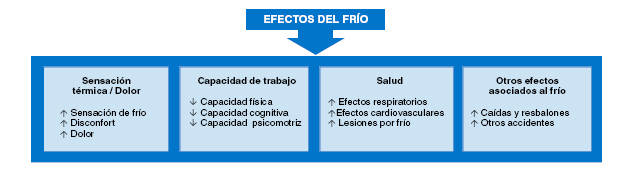
- Thermal sensation of cold and pain: when excessive heat loss occurs in all or part of the body, a sensation of cold, discomfort or even pain.
- Work capacity: the drop in temperatures in the work area can cause a decrease in manual dexterity, mental, and physical ability.___
- Health effects: may have respiratory effects (from irritations up to broncho-spasms), cardiovascular effects and cold injuries (due to localized cooling without freezing or with frostbite and due to general cooling of the body with hypothermia, the most serious of all).
- Cooling: may be from the extremities, cutaneous by wind-induced cooling, contact cooling and respiratory tract cooling.
Assessment of risks due to cold
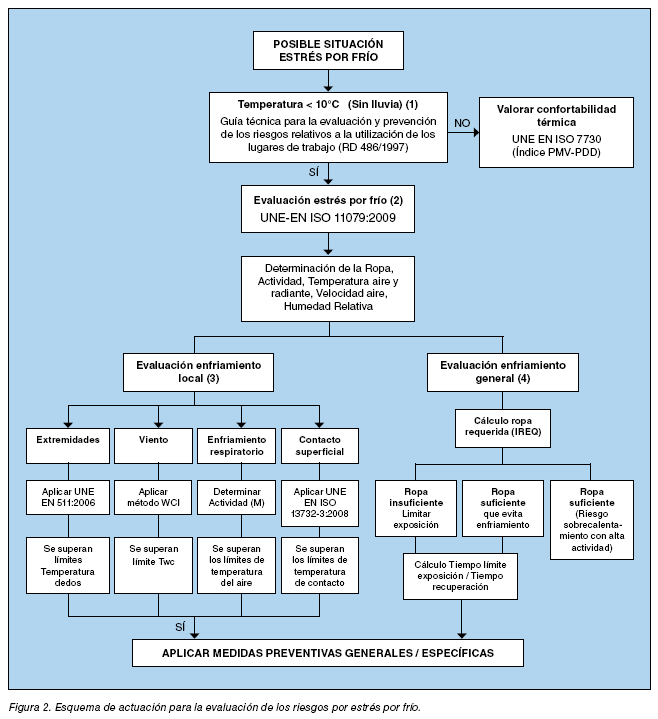
Once the effects that the risk of cold stress can cause are known, as in all cases, an adequate and complete risk assessment must be carried out. In the two technical notes on prevention of INSST 1.036 and 1.037 that you can find attached, it is explained in a simple way how to carry out this type of evaluation with very clear examples and concise.
___Prevention measures for exposure to cold
As we have already mentioned previously, there are many personal factors that influence each person's reaction to the cold, such as age, general state of health or age. morphology. However, there are certain prevention measures, both general and specific, that can be used for all workers.
Collective measures: Even if the work is carried out outdoors, it is advisable to have a place or booth with heating in which to consume hot drinks. Furthermore, in interior work, installing insulation or automatic mechanisms that reduce the manual workload are two very appropriate measures.On the other hand, it is also advisable to plan outdoor activities considering the weather forecast whenever possible.
___HTML TAG239___
Personal measurements: To reduce body heat loss, it is advisable to select appropriate clothing that also facilitates sweat evaporation. In this sense, it should be noted that in certain jobs, clothing functions as PPE in the prevention of occupational risks. Other prevention measures are the intake of hot liquids, reducing coffee consumption, replacing damp clothing, as well as controlling the pace of work. In addition, the supply of external heat is also essential by establishing pauses to warm up in an enabled zone.
A industrial level it is also worth remembering that recently in the BOE of the past On October 24, Royal Decree 552/2019, of September 27, was published, which approved the Safety Regulations for refrigeration installations and their complementary technical instructions. This regulation has contributed greatly to enhancing and promoting safety in refrigeration facilities, normally intended to safely and effectively provide the cold and air conditioning services necessary to meet the hygrothermal and hygienic conditions required in the processes. industrial.
___HTML TAG296___
At Fraternidad-Muprespa we work to reduce the accident rate of our mutual members and disseminate a culture of prevention and to do so we have our web portal dedicated to the prevention of occupational risks and development of a culture of health Previene where you can find interesting informative material with entertaining and specialized content that we encourage you to consult.