
III Work Road Safety Week: "Legal reforms"
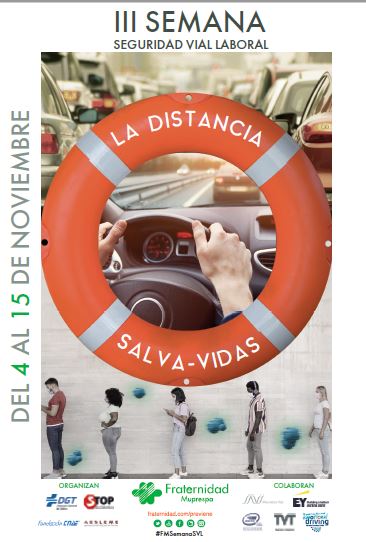
Fraternidad-Muprespa celebrates the III Workplace Road Safety Week from November 4 to 15 with the aim of raising awareness among our mutual members about the importance of road safety to reduce work accidents and road accidents work.
Our week coincides with the approval by the Council of Ministers of a package of legal reforms that, as a whole, substantially modify the legislation on traffic and circulation. The objective of these legislative changes is to generate a new road safety model aligned with the policy of the European Union and the recommendations of the World Health Organization to reduce, over the next decade, the number of deaths and serious injuries in traffic accidents by 50 percent.
First of all, the Preliminary bill that reforms the consolidated text of the Law on traffic and circulation of motor vehicles has been approved in everything related to the permit and driving license for points.
The modification incorporates the following notable measures:
- Increases the points deducted from 3 to 6 for driving while holding mobile phone devices in your hand.
- Increases from three to four the points that are deducted for not using the seat belt, child restraint systems, helmet and other protective elements. Furthermore, it explicitly incorporates the misuse of these elements (for example, wearing a protective helmet or unfastened seat belt) as a cause of sanction because the negative consequences for the driver's safety are the same.
- It classifies as a serious infraction having radar or speedometer detection mechanisms in the vehicle, which will result in a fine of 500 euros and the loss of three points.
- The reform eliminates the possibility that passenger cars and motorcycles can exceed the speed limits on conventional roads by 20 km/h when overtaking other vehicles.
- Introduces the possibility of recovering 2 license points for completing safe driving courses certified by the General Directorate of Traffic.
- The reform unifies into two years the period that must pass without committing infractions to recover the initial balance of points, a period that now varies depending on the severity of the infraction committed.
- Includes a new very serious violation, committing fraud in driving tests using unauthorized intercom devices. The penalty will be 500 euros and a penalty of 6 months without being able to take the exam.
- Online access to the driver registry is planned for people and goods transport companies so that they can know if their workers' driving license is valid or not.It will only be reported in red or green depending on whether it is current or not.
Secondly, a Royal Decree has been approved that modifies both the General traffic regulations and the vehicle regulations regarding urban traffic regulatory measures.
This new standard redefines the general speed limits on urban roads (article 50) based on their different classification:
- On roads that have a single carriageway and sidewalk platform, the limit will be 20 km/h.
- On roads with only one lane in each direction of travel, the limit will be 30 km/h.
- On roads with two or more lanes in each direction of travel, the limit will continue to be 50 km/h.
These limits will not be applied until six months after the publication of this project in the Official State Gazette, so that citizens know them adequately and so that public administrations have sufficient time to adapt the signage.
The second major area of impact of this Royal Decree is the regulation of personal mobility vehicles, defined as vehicles with one or more wheels equipped with a single seat and propelled exclusively by electric motors that can provide the vehicle with a maximum speed between 6 and 25 km/h.
This definition, which excludes vehicles for people with reduced mobility, means that their circulation on sidewalks and in pedestrian areas is prohibited. They will have to comply with traffic regulations like other vehicles and their circulation on interurban roads, crossings, as well as highways and highways that run within towns or in urban tunnels is also prohibited. Furthermore, in order to circulate, personal mobility vehicles must have the corresponding circulation certificate that certifies that they comply with a series of technical requirements.
Finally, the Council of Ministers has approved a Royal Decree that reforms the General regulations for drivers to partially incorporate the European Directive relating to the initial qualification and continuous training of drivers of vehicles intended for the transport of goods or passengers by road.
Its main points are:
- The minimum age required to drive trucks is reduced to 18 years after passing the Certificate of Professional Aptitude (CAP) of 280 hours. Until now the established age was 21 years.
- The minimum age required to drive coaches is also reduced to 18 years, but only without passengers and within a maximum radius of 50 km. It will only be from the age of 21 and with the CAP of 280 hours when they will be able to carry passengers.
- Extends from 3,500 kg to 4,250 kg the weight of vans that can be driven in national territory with the B permit for the transport of goods, only when the increase in mass is due to the new propulsion systems. It is a measure that favors the use of non-polluting alternative fuels.
- Specifies the mandatory protective equipment that applicants must wear in the skill and circulation tests to obtain motorcycle permits.
- Establishes the possibility that, in certain cases and after individualized medical and mechanical evaluation, access to truck and bus driving licenses may be authorized for people with problems associated with the locomotor system.