
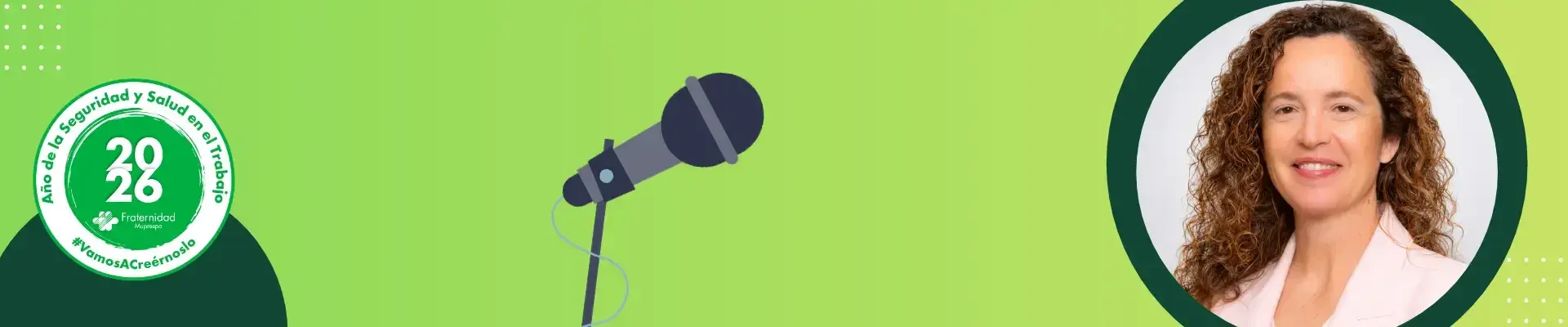
María Lurueña, director of INVASSAT: “2026 must serve for the PRL to gain visibility and prominence”
The journey to promote and promote the prevention of occupational risks, the axis of the campaign initiated by We have chatted with María Lurueña, general director of Labor, Cooperatives and Occupational Safety of the Generalitat Valenciana and also director of the Valencian Institute of Safety and Health at Work (INVASSAT).
Graduate in Law and official of the Labor and Social Security Inspection Corps, she has a solid career linked to the labor field, risk prevention and the management of public employment policies. Recognized for her technical and dialogue profile, Lurueña works to reinforce the preventive culture and move towards a more sustainable, safe and committed work model with the well-being of people.
2026 has been declared the Year of Safety and Health at Work. What meaning does this declaration have for your Autonomous Community and what opportunities does it open to reinforce the preventive culture in your territory?
The declaration of 2026 as the Year of Safety and Health at Work represents an extraordinary opportunity to place prevention at the center of public policies, business management and social awareness. Beyond a commemoration, it represents a collective call to reinforce the commitment to protecting the health of workers and to consolidate an authentic preventive culture in all areas of society.
In the Valencian Community, this declaration acquires special relevance because it coincides with the deployment of the new Valencian Strategy for Safety, Health and Well-being at Work 2025-2029, a roadmap agreed upon within the framework of social dialogue that places people at the center of prevention and which is fully aligned with the Spanish Strategy for Safety and Health at Work 2023-2027. For us, prevention should not be understood only as a legal obligation, but as a social value and an investment in well-being, competitiveness and sustainability.
Safer and healthier companies are also more resilient, more productive and better able to attract and retain talent
Furthermore, this Year of Safety and Health at Work offers us the opportunity to make visible some of the great challenges that are transforming the world of work: digitalization, teleworking, the aging of the working population, mental health, psychosocial risks, the ecological transition and the effects of climate change on working conditions. Both the state and Valencia strategies identify these challenges as priorities for action for the coming years.
From the Generalitat Valenciana we want to take advantage of this impulse to intensify awareness, training and dissemination of good practices; strengthen collaboration with companies, mutual societies, business and union organizations; pay special attention to microenterprises, SMEs and the most vulnerable groups; and move towards a more comprehensive vision that incorporates not only safety and health, but also workplace well-being. In short, 2026 must serve to ensure that prevention gains visibility and social prominence.
Our goal is for more and more organizations and people to understand that safety and health at work are not a secondary issue, but rather an essential element to build a safer, healthier and more competitive Valencian Community.
How do you think the work of mutual societies fits within the preventive system of your community and what improvements or lines of work do you think could be introduced to improve the preventive culture of our mutual members?
The Mutual Collaborators with Social Security play a fundamental role within the preventive system, not only for their role in the management of professional contingencies, but also for their ability to bring prevention closer to companies and workers through advice, training, awareness and the dissemination of good practices.
Their direct and permanent contact with companies of all sizes, especially small and medium-sized companies, gives them a privileged position to detect needs, transfer technical knowledge and promote more effective preventive management. In a business reality like that of the Valencian Community, where the productive fabric is made up mainly of SMEs and microenterprises, this work is especially valuable.
Furthermore, mutual societies are strategic allies to advance some of the objectives shared by both the Spanish Occupational Health and Safety Strategy and the Valencian Occupational Safety, Health and Welfare Strategy: integrating prevention into business management, strengthening the preventive culture, improving the protection of the most vulnerable groups and anticipating emerging risks associated with transformations in the world of work. Regarding lines of improvement, I think there is room to continue strengthening various actions.
What are these possible lines of improvement?
Firstly, intensify awareness-raising actions aimed at company management. The preventive culture is consolidated when prevention is part of the business strategy and has visible and committed leadership.
Secondly, it is important to move towards more personalized approaches, especially for SMEs and microenterprises, providing practical, simple tools adapted to their reality. Many times it is not a question of lack of will, but of difficulties in transferring preventive requirements to daily management.
We must continue promoting actions related to emerging risks, particularly psychosocial risks
We must also continue to promote actions related to emerging risks, particularly psychosocial risks, mental health, the impact of digitalization, the aging of the working population and the effects of climate change on working conditions. These are increasingly relevant areas that require innovative and coordinated responses.
Another especially interesting line is to promote the exchange of good practices between companies. Successful experiences have a great capacity to generate cultural changes, because they demonstrate that investing in safety and health brings real benefits for both people and organizations.
Finally, I believe that we must continue to strengthen collaboration between public administrations, mutual societies, social agents and the business community. Improving preventive culture is a shared objective that requires the participation of all actors. No organization can achieve this alone. In short, mutual societies are a key element in bringing prevention closer to the day-to-day life of companies. Their capacity for influence, knowledge and proximity make them essential agents to continue moving towards a more solid, participatory preventive culture oriented towards the well-being of workers.
What assessment do you make of the main plans developed in the Valencian Community related to Safety and Health at Work and against workplace accidents?
In reference to the Valencian Strategy for Safety, Health and Workplace Welfare 2025-2029, our assessment is very positive because it constitutes the main planning instrument for the preventive policies of the Generalitat for the coming years. This is a strategy agreed upon in the field of social dialogue, aligned with the Spanish Strategy for Safety and Health at Work and aimed at responding to the great challenges that the world of work is experiencing, such as digitalization, psychosocial risks, the aging of the working population or the effects of climate change on working conditions.
If we look at the degree of implementation in companies and the Action Plans against Occupational Accidents in the Valencian Community, the assessment is also clearly positive. This is a consolidated tool that INVASSAT has been developing for years and that allows specific preventive actions to be directed towards those companies that have higher incidence rates or particularly serious accidents.
We direct Action Plans against workplace accidents where there is the greatest need for improvement
These plans represent an example of prevention based on data analysis and targeted intervention where there is a greatest need for improvement. Beyond their control and monitoring component, they have a marked preventive nature, since they promote internal reflection by companies on their results, their management systems and the measures they can adopt to reduce occupational risks.
Regarding their implementation, I consider that they have reached a significant degree of maturity and are widely known by the affected companies. Furthermore, they have contributed to reinforcing the perception that workplace accidents are not an inevitable phenomenon, but rather a reality that can be acted upon through adequate preventive planning, analysis of the causes and adoption of effective measures. However, the true implementation of prevention cannot be measured solely by compliance with certain actions or procedures.
The great challenge remains to ensure that health and safety are part of the management culture of organizations and are present in all business decisions, from work organization to the incorporation of new technologies or investment planning. That is why we will continue working so that companies advance from a vision based exclusively on regulatory compliance towards a more mature, participatory and proactive preventive culture. On this path, collaboration between the Administration, mutual societies, social agents and the companies themselves is essential.
Interview with Elirerto Galván, director of ICASEL
Interview with Pilar Simón, director General of Labor and Occupational Health of La Rioja