
New infographic to detect TME risks
As part of the campaign promoted by EU-OSHA: "Healthy jobs: let's relax the burdens", from Fraternidad-Muprespa we are carrying out virtual actions every month throughout the period 2020-2022 related to musculoskeletal disorders and their prevalence over time.
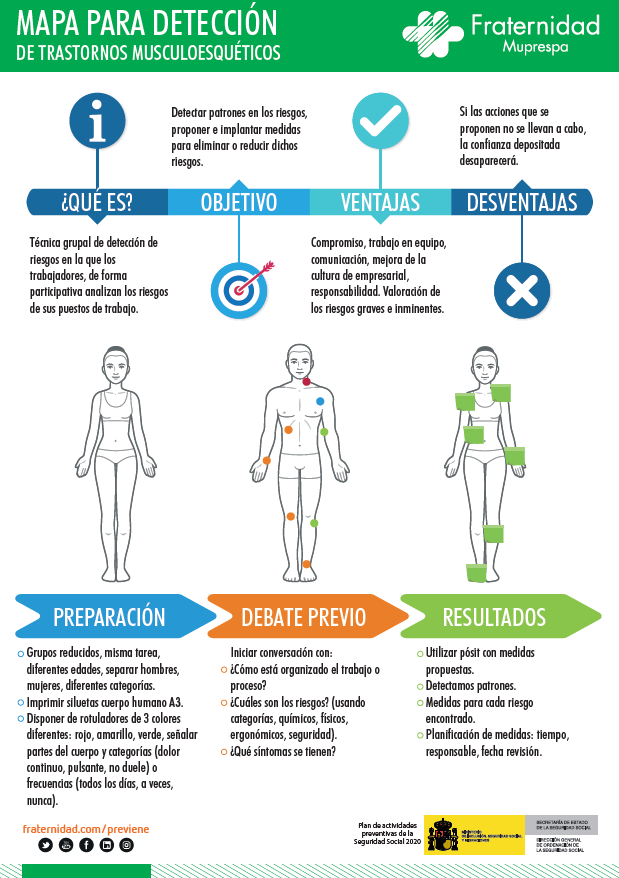
On this occasion we present an infographic that in a very visual way explains the different steps that must be carried out to make a map that detects musculoskeletal disorders, what is usually called TME risk mapping. It is a quick technique that we can not only use to detect risks that generate musculoskeletal disorders but also any other type of risk, such as risks in a process or a workplace, for example, an office. It has different advantages:
- Simple: in 3 short phases we will obtain measures to implement
- Cheap: we only need different markers and print several silhouettes of the human body in A3
- Collaborative: this technique is based on the participation of a group of workers moderated by the expert in occupational risk prevention
This technique is a double tool, since in addition to detecting risks, by being collaborative we will involve workers and managers in the prevention issues that concern them, increasing teamwork and communication. When we involve everyone involved, we are reinforcing their commitment to the company. By feeling like protagonists, they become more involved, in addition to verifying that the company cares about its workers and, most importantly, wants to propose measures to stop them.
We explain a little more, below, the most interesting part, which is the formation of the groups that will help us detect the risks, probability, frequency and measures to implement. The groups of people must have some common characteristics in order to have a more representative sample, among them:
- We separate men from women, since both may have different risks or affected body parts, or different frequencies, due to their different anatomies.
- The groups will belong to the same process or machine whose risks we want to detect, so that all of them know said process.
- If we want to determine the risks by age, we will make groups based on this item.
- It would also be appropriate to mix different categories of workers, so that we get different perspectives.
In this way, in a simple way, we obtain risk patterns by age, experience, type of process, which makes it much easier to see which risks we have to immediately take measures on.
The other axis on which the tool pivots is what questions we want to answer ourselves or the proposed groups to answer us, for example, do we want to see the risks at this moment or those that have been happening for some time? Do we want to detect risks or damages? For this, the moderator and expert will have to first calmly consider what the objectives are that they want to obtain.
This is not a new technique, we bring it here because we find it interesting, suitable for detecting musculoskeletal disorders but also because it is in line with everything we have been saying about cultural change and Vision Zero.
From Fraternidad-Muprespa, in our desire to help our associated companies, we continue in our search for tools that improve their preventive culture and thus make it easier for them to go to the next level in prevention.