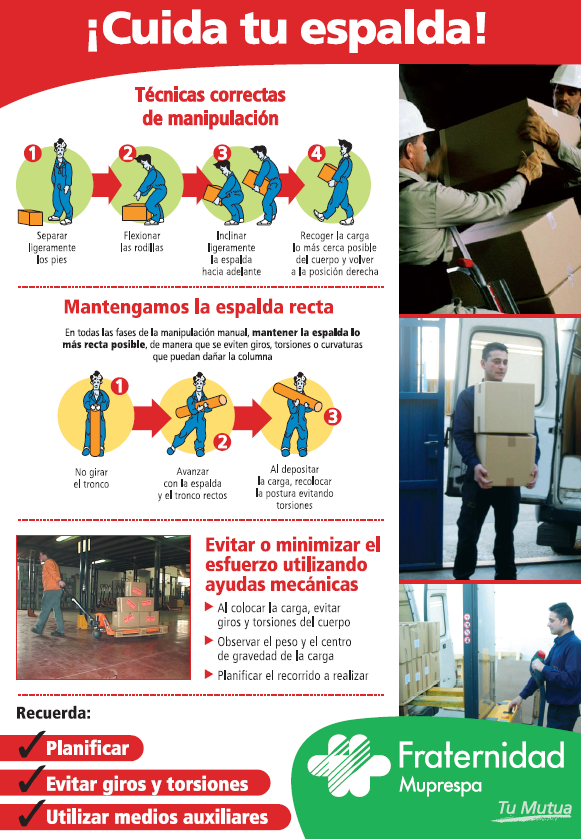

Repetitive movements, solutions.
We continue with the news with the same theme, within the European Week for Safety and Health at Work, contributing to the campaign:
belonging to the European Agency for Safety and Health at Work, EU-OSHA.
Today we will talk about repetitive movements, and we will give some ideas of good practices that we can implement to stop them. The first thing is to define what we mean by repetitive movement and what the influencing factors are:
___When we talk about repeated movements we refer to all those activities repetitive type that involve efforts or rapid movements of small muscle groups, generally of the upper extremities, aggravated by the maintenance of ___postures forced ___and one ___lack of recovery muscle___.
___Factors influencing movements repetitive:
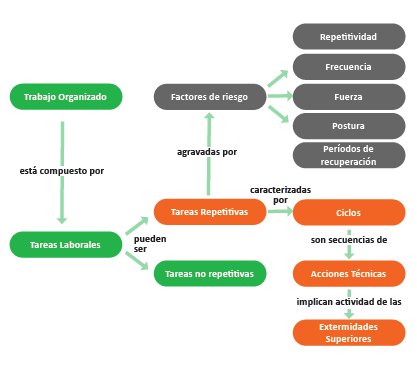
___- Repetitiveness, ___H TMLTAG146___understood as such the number of times the task or action is repeated in a similar way.
______- Frequency of movements, o actions in a given time, which are influenced by the repetition and speed of the movements, along with the ___H TMLTAG198___duration of repetitive work.
______- ___ HTMLTAG236___Strength ___H TMLTAG250___required to carry out the action, including the time in which it must be applied.
___- ___H TMLTAG288___Postures adopted and movements made, ___HTM LTAG302___distinguishing the area(s) of the body involved (hand, wrist, elbow, shoulder,…).
______- ___ HTMLTAG340___Period recovery y Rest breaks necessary to recover from the task.
______In addition to those factors, There are others that can influence, such as the planning of the task, characteristics of the person, type of tools and auxiliary means, humidity, cold, vibrations...
______Where we can find examples, among others:
- ___Continuous handling of hand tools (screwdrivers, wrench, hammer…)
- ___HTMLTAG4 48___ORperar ___in two work areas ___different turning the trunk.
- ___Tasks that involve continuous movement of arms (painting, sanding, sweeping, scrub…)
___Well, what can we do to minimize its consequences:
- ___Decreasing the number of repetitions and frequency.
- ___Extending the recovery time.
- ___Reducing the force exerted.
- ___Work organization to include pauses.
- Implementing ergonomic tools that automate the task.
We bring an example belonging to our guide of good practices for the prevention of musculoskeletal disorders, prepared in collaboration with Prevencontrol.
Repetitive movements in the agricultural sector:
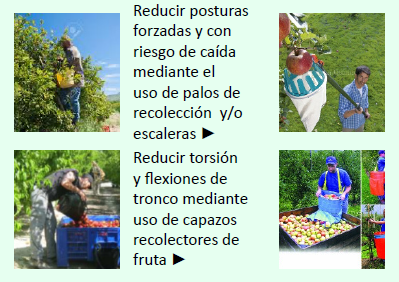
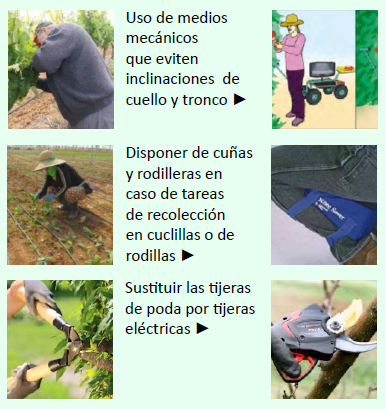
Work in the field involves a wide range of MSDs due to the great physical effort that, added to the repetitive nature of many tasks and the maintenance of body postures for a long time, poses a considerable risk of injuries due to repetitive movements. To avoid all this we can implement a battery of measures that graphically can be:
To finish, reader, you've been sitting for a while, wake up! wake up! wake up!!!, we propose a warm-up exercise, this way we demonstrate that movement is demonstrated by walking:
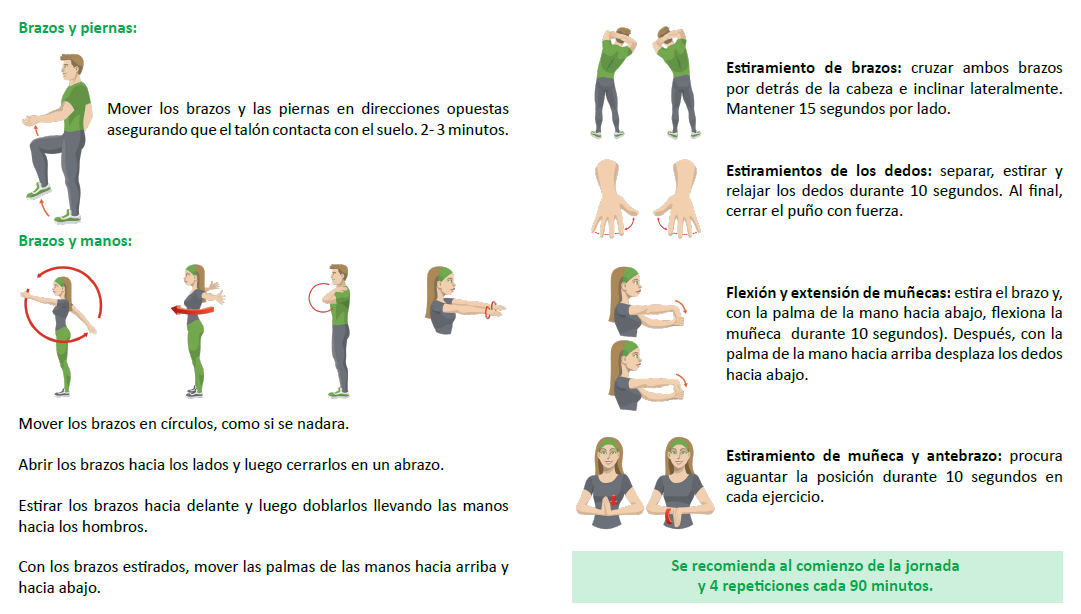
At Fraternidad-Muprespa we hope that these guides are of interest to our mutual members, meet their expectations by predominating practical cases and help to strengthen the necessary preventive knowledge, as well as the implementation of preventive measures that can be effectively transferred to the workplace, thus guaranteeing the safety, health and well-being of employees. workers.