

Safe return to classrooms. Questions and answers 11/12/2020
We have not found specific ministerial guidelines in this regard. In the event that any autonomous community specifically regulates this section, its instructions must be followed.
As a preventive criterion, we recommend moving school supplies as little as possible to avoid cross-contamination. However, it is difficult to avoid these transfers on a daily basis when the support material is books and notebooks. We recommend insisting on raising awareness among students so that they observe basic prevention and cleaning measures when transporting and using this school material.
Regarding extracurricular backpacks, if access is authorized, we recommend that they follow the same rules that will apply to school backpacks, which each center will have defined in its Contingency Plan.
Yes, as long as it is disinfected for someone else to use.
Yes. They will be used as determined in the Contingency Plan of each center, which will have been determined based on its characteristics (number of students, ages, available toilets, dimensions, locations, etc.) and with the guidelines, if any, of each Autonomous Community.
At the ministerial level there is only an indication referring to Special Education where it indicates that "A toilet will be assigned for every 1-2 groups, if possible. If not, cleaning and disinfection will be intensified." (document “Prevention, hygiene and health promotion measures against COVID-19 for educational centers in the 2020-2021 academic year, version 06-22-2020)
The established cleaning protocols must be complied with, and the provision of material for cleaning and drying hands must be maintained.
Strategies that guarantee the limitation of contacts while maintaining a safe distance must prevail (for example, assigning toilets to groups specific times at certain times, limiting capacity or canceling the use of nearby cabins or sinks) and that promote personal hygiene
.Currently, yes, from 6 years old. The Ministry establishes the obligation to use a mask both indoors and outdoors, even if a safe distance can be maintained, for ages 6 and up.
Preventively, the use of a mask prevents microdroplets from depositing on surfaces and becoming a source of contagion and we also reduce the creation of aerosols.
You must refer to the list of virucidal products authorized in Spain published by the Ministry of Health, where the composition of each product appears and whether it is for general or professional use.
Sanytol is included in this list. In any case, we recommend consulting directly with the manufacturer or distributor or, where appropriate, with the cleaning contract, the product safety sheet, its instructions for use and application time.
From a preventive point of view, it is not convenient. If it is allowed, we recommend avoiding bulk products and taking extreme hygiene measures in the distribution and consumption of the products.
Applying the principle of prudence, any suspicion of special vulnerability must be consulted with the Occupational Risk Prevention Service.
The Occupational Risk Prevention Service will determine the vulnerability in each specific case as indicated in the document “Procedure of action for occupational risk prevention services against exposure to SARS-CoV-2”. As of the date of this review (12-11-2020), the October 7 version of the document is current. It is recommended to check the version that is applicable at all times.
By applying the basic measure of hand cleaning and observing the safe behavior of avoiding touching the mucous membranes, the risk of contagion when handling this material is minimized. The added use of a face shield helps avoid touching your face.
They will be used as determined in the Contingency Plan of each center, which will have been determined based on its characteristics (number of students, ages, available toilets, dimensions, locations, etc.) and with the guidelines, if any, of each Autonomous Community. At the State level, there is only one indication referring to Special Education where it indicates that "A toilet will be assigned for every 1-2 groups, if possible. If not, cleaning and disinfection will be intensified." (document “Prevention, hygiene and health promotion measures against COVID-19 for educational centers in the course 2020-2021 version 06-22-2020 )
Strategies that guarantee the limitation of contacts must prevail (for example, assigning toilets to specific groups at certain times and limiting capacity) and that promote personal hygiene
.Unless a specific regulation indicates otherwise, applying the basic principles of prevention, a mask should be used when singing, in order to avoid the dispersion of droplets or aerosols in the environment, unless a sufficient safety distance and effective air renewal (ventilation) of the place where it is performed is guaranteed
The use of instruments for the exclusive use of each student must be prioritized, and we specifically recommend not sharing wind instruments. If instruments are shared, their disinfection with authorized virucidal products must be guaranteed.
In Cantabria, for example, it was established at the end of August ( https://boc.cantabria.es/boces/verAnuncioAction.do?idAnuBlob=353219 ) :
“ In Music and Dance Teachings, the use of a mask will be mandatory and interpersonal distance of at least 1.5 meters will be maintained. In wind specialties, in moments of instrument practice that make it unfeasible the use of a mask, an interpersonal distance of at least 3 meters will be necessary. If this is not possible, screens or other separation elements will be used.
In case of sharing musical instruments (piano, percussion...) and other resources, hygiene and prevention measures will have to be taken to the extreme (such as hand hygiene) and cleaning will be carried out between the use of one group and another. For its part, the Junta de Castilla y León has prepared the “Guide for music conservatories in a COVID-19 pandemic situation” (without an explicit date in the document), which sets out preventive measures that can serve as a reference, in music or singing classes, in the absence of national or autonomous measures. You can consult the pdf at http://conservatorioleon.centros.educa.jcyl.es/sitio/upload/GUIA_PARA_CONSERVATORIOS_DE_MUSICA_FINAL.pdf in the site http://conservatorioleon.centros.educa.jcyl.es/sitio/
The question is open and would require a very extensive answer. Ministerial guidelines on education do not specifically address this issue.
Currently, the generic guidelines impose the mandatory use of a mask during the stay in schools, except for the normatively accepted exceptions, among which are the performance of physical exercise (we understand that intense physical exercise). Preventively, the basic principle of limiting contacts (individual activity and with a safe distance) and carrying out the activity in open-air or well-ventilated spaces must be applied. Also insist on personal hygiene measures and observing the safe behavior of avoiding touching the mucous membranes during the activity.
We recommend reading the document published on 09-16-2020 by the Government of the Canary Islands, which addresses this matter in depth, “ Guidelines for safe and quality PHYSICAL EDUCATION in the educational centers of the Canary Islands. Course 2020-2021”, which, in turn, is based on the COLEF (General Council of Physical and Sports Education) document “Teacher recommendations for safe and responsible school Physical Education in the face of the “new normal”
.According to the Ministries of Health and Education, the mask indicated for the healthy population will be hygienic and, whenever possible, reusable.
In the case of teachers, also hygienic type, unless another type is indicated by the occupational risk prevention service.
If a suspicious case appears, a surgical mask will be placed on you and the accompanying person as well.
Exceptionally, when the child who has started symptoms cannot put on the surgical mask for any reason (for example: children under 6 years of age who do not tolerate it, people with respiratory problems, who have difficulty removing the mask on their own or who have behavioral changes that make its use unfeasible), the person accompanying them to care for them will put on an FFP2 mask without a valve, in addition to a face shield and a disposable gown.
Currently, the use of homemade masks is discouraged and all masks must comply with the certifications corresponding to their category.
The duration of use will depend on the manufacturer's instructions. For reasons of comfort and hygiene, it is usually recommended not to use the mask for more than 4 hours. If they are reusable, the manufacturer will indicate the maximum number of washes.
The center will have surgical masks to use in the event that someone starts symptoms, and hygienic masks for teachers and to be able to replace the students' masks, in case of need or forgetfulness.
You will also have FFP2 and a screen for cases in which the suspected case cannot put on the mask (described above).
We have not found a specific reference for this aspect.
If the teacher travels from one center to another on the same day, the basic safety standards required for the means of transportation used must be followed.
At the entrances to each center, the specific disinfection measures that have been established will be complied with, and if once inside the protocols are followed, cross-contamination situations are considered very unlikely.
In the event that a teacher has been classified as a close contact in a center, they must notify the rest of the centers where they carry out their activity to activate the case management protocols.
In Cantabria, for example, it was established at the end of August ( https://boc.cantabria.es/boces/verAnuncioAction.do?idAnuBlob=353219 ) :
“ In Music and Dance Teachings, the use of a mask will be mandatory and interpersonal distance of at least 1.5 meters will be maintained. In wind specialties, in moments of instrument practice that make it unfeasible the use of a mask, an interpersonal distance of at least 3 meters will be necessary. If this is not possible, screens or other separation elements will be used.
In case of sharing musical instruments (piano, percussion...) and other resources, hygiene and prevention measures will have to be taken to the extreme (such as hand hygiene) and cleaning will be carried out between the use of one group and another. For its part, the Junta de Castilla y León has prepared the “Guide for music conservatories in a COVID-19 pandemic situation” (without an explicit date in the document), which sets out preventive measures that can serve as a reference, in music or singing classes, in the absence of national or autonomous measures.
You can consult the pdf at http://conservatorioleon.centros.educa.jcyl.es/sitio/upload/GUIA_PARA_CONSERVATORIOS_DE_MUSICA_FINAL.pdf on the site http://conservatorioleon.centros.educa.jcyl.es/sitio/
Reference must be made to the specific protocol of each autonomous community, which must specify the actions included in the “Guide to action in response to the appearance of COVID19 cases in educational centers” .
As of the date of this review, the current version of the guide indicates:
- The student must be accompanied to the COVID room by a teacher, both wearing a surgical mask.
- The center will call the parents, and will initiate the protocol with their public health service or reference center.
- Until confirmation of a positive or negative case, the class activity continues.
- The siblings of the suspected case enrolled in school at the same center or at any other center will also remain at home until the results of the tests are obtained, as they are cohabiting family contacts.
Of course, in the event of confirmation of the positive result of a suspected student, all cohabitants are close contact, so they must quarantine on the days indicated by the health authority.
As of the date of this review, the current version of the guide (September 24) indicates that siblings of suspected cases must also remain in quarantine until the result of the diagnostic test.
At the entrances to the bubble classroom, hygiene measures must be taken, especially in groups up to 6 years old who do not wear a mask.
Extremely clean your hands, and try to avoid excessive closeness with the students.
In our technical opinion, in preschool students, it is considered necessary to disinfect footwear prior to entering the classroom, such as a mat soaked in disinfectant, or other equivalent measures such as changing footwear, or using plastic booties (shoe covers), which are for single use.
The occupational risk prevention service can assess in each specific case the use of an FFP2 mask to intensify respiratory protection.
No. The face shield is a good protective complement if used together with the mask, but it does not replace it.
Only in cases where there is an exemption from using a mask, the use of the facial screen can be considered as minimum protection against the projection of droplets, as long as its use does not maintain the risks or discomforts the mask created in these cases.
Yes. As long as both parties use a mask and perform adequate hand hygiene (before and after), and avoid direct contact and reduce the interaction time to the minimum possible (less than 15 minutes is recommended).
Follow the general recommendations of the Ministry of Transport or any other regional or local body with powers in the matter.
In this regard, in this link there is a brief description of preventive measures and infographic from the Ministry of Transport, Mobility, and Urban Agency: Tips and recommendations for a safe trip to work
The measures must have been studied in the contingency plan of each center based on its characteristics, both structural of the rooms and the volume of users of these services.
There are a series of general measures (non-exhaustive list):
- These rooms must have a limited capacity, which must be signposted.
- They must have hydroalcoholic gel at the entrance.
- They must remain ventilated
- They must be disinfected after each shift and at the end of the service.
Dining room:
- Tables must be organized so that the established safety distances are maintained. Take measures to ensure this compliance, such as blocking or directly removing the chairs that should not be used due to occupancy.
- Whenever possible, maintain fixed seats for each student.
- The use of a mask is mandatory for all staff serving the dining rooms. They should preferably wear their hair up.
- Once students are seated to eat, they can remove their masks during the meal, but must put them on when they finish.
- Students who belong to a stable coexistence group will be able to sit at the table together, but maintaining a safe distance from the rest of the groups.
Early bird classes:
- Whenever the situation allows, it would be advisable to respect the coexistence groups of the school day in these classes. Breaking these coexistence groups, in addition to making contact control difficult, would mean substantially multiplying the narrow cases that would have to be quarantined in the event of a positive.
- In the event that students from different stable groups and/or students from other levels are accommodated in the same space, these groups must be separated by a wide safety distance (in some autonomous communities it has been extended to 3 meters).
- We recommend maintaining a distance of at least 1.5 meters between students who are not part of stable groups.
- The spaces used as early bird classes must be cleaned and disinfected after use and, in any case, before the start of the school day. We recommend that they be especially well-ventilated rooms and, as long as the weather permits, you can consider using the patio or any other outdoor area or as large and open-plan as possible.
The risk level of said activity must be specified in the contingency plan and the center's cleaning plan.
These protections will have been determined in the center's Contingency and Cleaning Plans, after an evaluation carried out by the Prevention Service.
Respecting the criteria of the Prevention Service, in general it would be advisable to maintain at least the same security measures that have been followed when the student and the teacher have been using the room. It is recommended that said cleaning work be carried out with at least disposable gloves and a surgical mask, if the student has remained with a mask during the waiting time, and with a gown, face shield, disposable gloves and FFP2 mask, in the event that the symptomatic student has remained in the room without respiratory protection,
From the preventive approach, not only can it, but it must. Another question is whether there is a legal norm that expresses itself to the contrary (we have no evidence).
The ministerial guidelines are clear regarding the mandatory use of a mask from the age of 6. Furthermore, the school could include this issue in the coexistence rules. Some centers that have required parents to sign the responsible declaration have included in it that the student is aware of the center's preventive measures and expresses their commitment to strict compliance with them.
Currently the use of the mask is mandatory from 6 years of age regardless of maintaining interpersonal distance, without prejudice to the exemptions provided for in the legal system. Therefore, a mask must be worn at recess.
Regarding the physical education class, consult the question What happens with physical education and COVID prevention?
It corresponds to public health service doctors, health care and the issuance of medical reports for discharge, confirmation and discharge, both in cases of contagion and in cases of quarantine or isolation.
In the ministerial guide to action in response to the appearance of covid-19 cases in educational centers (version September 24), it is indicated:
- Close contact: must be quarantined.
- Father of an infected child: must be quarantined.
- Father of child suspected of contagion (the one who presents symptoms): the rule does not specify anything about quarantine.
However, as of the date of this review, the current version (November 12) of the document “Strategy for early detection, surveillance and control of covid19”, in section D point 2, mentions the following in reference to the cohabitants of a suspected case: “In case of any suspected case, it is indicated to begin the identification and control of their close contacts with cohabitants, recommending them. avoid social interactions.”
There is no specific ministerial guideline on swings, although the general indication is not to share materials. At the community level, regional and local authorities are once again closing public children's recreation areas.
On the contrary, we could also assess whether the risk reduction represented by the indiscriminate preventive measure of avoiding the use of swings compensates for the negative aspect of depriving the little ones of the enjoyment of recreational elements that contribute to their emotional well-being.
The magnitude of the risk of contagion posed by the use of swings will depend on their dimensions, their location (ventilated area or not), the degree of compliance with the basic principles of prevention (swings disinfected before and after use, whether or not a mask is used, hand hygiene, avoiding crowds, avoiding direct physical contact) and whether children comply with safe behaviors (avoid touching their face, avoid dispersing droplets in the environment, etc.). Given their age, maintaining these measures and safe behaviors will likely require continuous monitoring by their guardians.
They are two totally different techniques, and they can provide results at different times of evolution of the disease, apart from possible errors in sampling, etc.
PCR serves us for early detection and monitoring/evolution of active disease, until its healing phase.
Serology gives us present and past information, of infection already overcome, but it is a poor indicator in very early, pre-symptomatic phases. Very useful to know percentages of the population that have overcome the disease.
We can have Positive Serology and be negative in PCR because they respond at different times, and do not detect the same thing. That is why the instructions of the health professional handling our case must be evaluated and followed.
The summary table below allows us to observe the different situations that we can find with the results of PCR and serological tests.
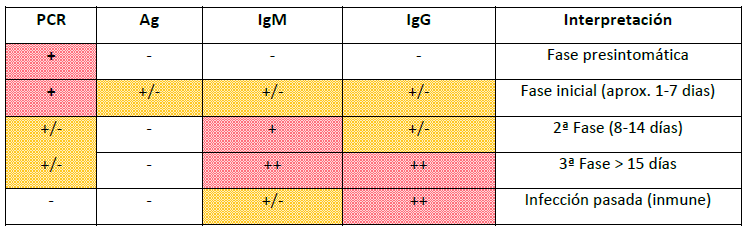
We added a web link to a publication from the Ministry of Health, which explains the interpretation of the diagnostic test. Interpretation of diagnostic tests against sars-cov-2 April 24, 2020
If you have a positive IG-G, Can you get sick and infected again?
The medical community has not yet reached a unanimous conclusion.
As of the date of this review, the current version (November 12) of the document “Strategy for early detection, surveillance and control of covid19”, indicates in section D point 1: “People who have already had a confirmed SARS-CoV-2 infection in the previous 3 months will be exempt from quarantine.”
In any case, people who have overcome the disease are obliged to maintain the same prevention measures established for the community.
The symptoms associated with COVID-19 are very varied, although the most common in childhood and adolescence are fever, cough, respiratory distress, sore throat and diarrhea. In addition, lack of taste and/or smell are common symptoms. Other symptoms such as chills, headache or muscle pain and general weakness have also been associated with the disease.
The Spanish Association of Primary Care Pediatrics considers that from 37.5º C it should be considered a case of fever and a reason not to go to daycare, school or institute.
In any case, autonomous communities such as Madrid (with 37.2) and the Basque Country (37) have expressly included low-grade fever as a reason for not going to school.
In case of doubt, it is always advisable not to take the child to school until the primary care doctor determines.
See question “Is there sick leave due to close contact with an infected or suspected child?” This question corresponds to the particular case of a father with a child suspected of being infected.
There is no specific ministerial guideline that mentions the obligation to disinfect footwear when entering the centers. In case of regional regulation, it must be complied with.
It is a preventive measure that is always positive, although we understand that it has special importance and that perhaps it should be promoted more and better controlled in infant classes, where the floor can be considered a potential fomite for children, who can carry out a large part of their activities on the floor. An alternative measure could be changing footwear when entering the classroom.
In the case of assistant teachers who move around the infant classrooms, disposable shoe covers could be used when accessing them.
Face shields are a good protection complement to the use of a mask, but the ministry only indicates its mandatory use (accompanied by an FFP2 mask) in the case of the teacher accompanying a student with a suspected case when said student cannot wear the surgical mask.
This situation is not contemplated in the ministerial case management guide. The school and the transport company must coordinate and process this assumption.
Like everything related to cleaning measures, it must be considered in the Cleaning Plan, realistically.
In the case of physical education material, it must be assessed whether the material is going to be used only once a day or several times.
If it happens several times, it may be impractical for the cleaning staff to review all the material used between classes, and what is clear is that in no case should material reach the student without having been previously disinfected. Therefore, in these cases, the possibility of the teacher carrying out this task should be studied, with the appropriate information and training in this regard that may be required.
It is convenient that the equipment that the teacher chooses for classes is easy to clean.
The Ministry of Health's case management guide for educational centers indicates:
“ If a person develops symptoms compatible with COVID-19 in the educational center [...] they will be taken to a separate space [...]. The space in which suspected cases wait will preferably be a room for individual use, previously chosen, that has adequate ventilation and a pedal bin with a bag [... ]”.
The COVID room must have the characteristics reflected in the guide, but it does not mean that at a necessary time another unit that meets the same criteria cannot be used.
It is important to organize an immediate cleaning of the COVID room after the departure of a suspected student, precisely to ensure its hygienic conditions in the event of using it again.
It is recommended that disposable tissues that staff and students use to dry hands or to comply with respiratory hygiene measures be discarded in bins with a bag and, if possible, with a lid and pedal.
All personal hygiene materials (masks, latex gloves, etc.) must be deposited in the rest fraction (grouping of household waste obtained once separate collections have been carried out).
In the event that a student or a worker presents symptoms while at the educational center, it will be necessary to isolate the bin or container where they have deposited tissues or other used products in the individual use space where they have been isolated. This garbage bag must be removed and placed in a second garbage bag, with a seal, for deposit in the remaining fraction.
It corresponds to public health service doctors, health care and the issuance of medical reports for discharge, confirmation and discharge, both in cases of contagion and in cases of quarantine or isolation.
Each case must be studied individually. We understand that the medical report will determine if the student can attend the center. If not, alternative measures will be enabled for monitoring the classes established by each autonomous community.
As of the date of this review (12-11-2020), in the current version (September 17) of the document “Prevention, Hygiene and Health Promotion Measures against COVID19 for educational centers”, point 4 (Case Management), paragraph 12, indicates the following: “Students who have health conditions that make them more vulnerable to COVID-19 (such as, for example, cardiovascular diseases, diabetes, chronic pulmonary diseases, cancer, immunosuppression or high blood pressure), you may go to the center, as long as your clinical condition is controlled and allows it, and rigorously maintaining protective measures, unless medically indicated not to attend."
If the student is unable to attend in person, alternative measures will be enabled for monitoring classes that each autonomous community has established.