
Dr. Hevia from Fraternidad-Muprespa, present at the SETLA webinar "Lumbar disc herniation"
Fraternidad-Muprespa participated on Saturday, April 24, in the Webinar on Lumbar Disc Herniation organized by SETLA, Spanish Society of Occupational Traumatology, that addressed the topic of this pathology from the perspective of professionals from different mutual insurance companies and the INSS.
The day was inaugurated by the president of SETLA Dr. Javier Vaquero, and continued with the welcome of Dr. Juan Antonio Aguilera, Head of the Spine Unit of Mc Mutual Clinics.
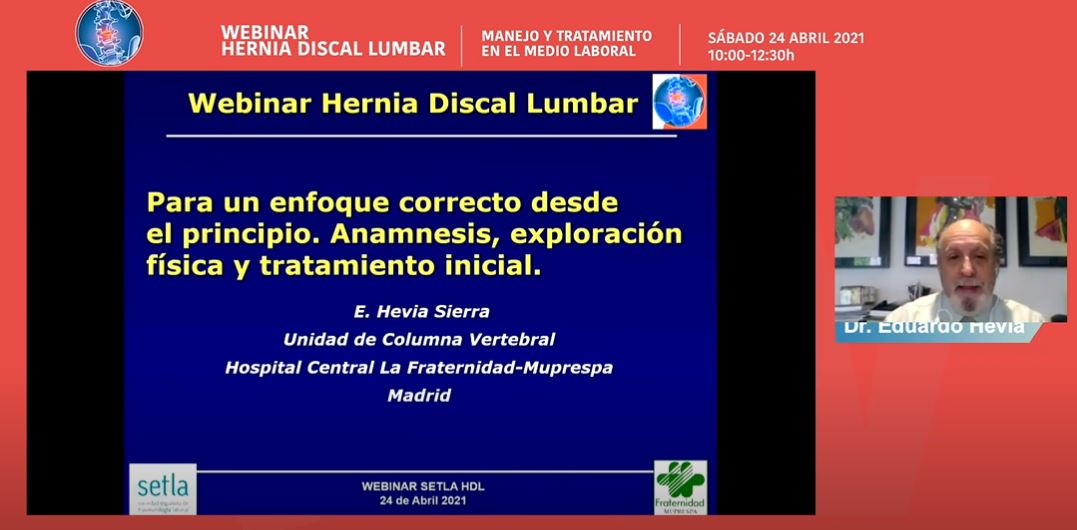
Representing the Mutual Fund, Dr. Eduardo Hevia, head of the Spine Unit at the Fraternidad-Muprespa Havana Hospital, who opened the session with the presentation "First Visit. For a correct approach from the beginning. History, physical examination and initial treatment", in which he highlighted that back pain is one of the causes of sick leave and disabilities in the workplace. The anamnesis, the physical examination and its correct diagnosis are essential in the first consultation, since it implies the acceptance or rejection of the process and gives meaning to the determination of the contingency of the TR.
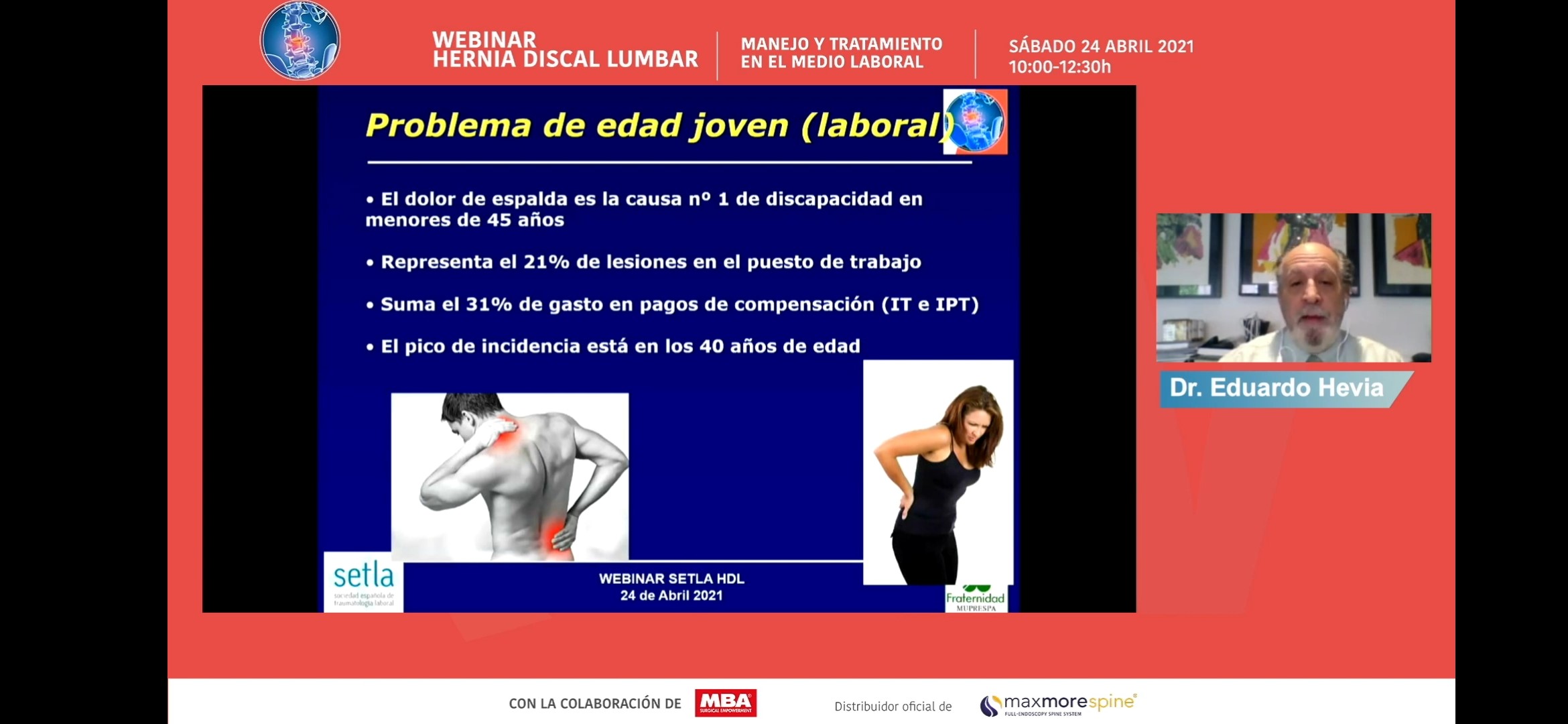
Back pain is the No. 1 cause of disability in people under 45 years of age, it represents 21% of workplace injuries and accounts for 31% of spending on compensation payments (IT and IPT). The peak incidence is at 40 years of age, in full employment.
Dr. Hevia pointed out some very significant data on pathology, based on the EPISER group Study Population impact of low back pain in Spain, published in the Spanish Journal of Rheumatology in 2002.
- 80% of the population suffers from it at some point in their lives.
- The possibility of suffering from an episode of low back pain in Spain is 44.8%.
- Low back pain generates more than 5.5 million queries in 6 months.
In addition, this produces a very high number of complementary tests (1,800,000 x-rays, 1,100,000 tests, 319,000 CT scans and 250,000 MRIs), generating a very high cost in relation to other pathologies.
Low back pain is a nonspecific syndrome, only in 10-15% of cases it is possible to determine the cause.Of the cases that last more than a month, 90% have a non-specific cause.
Low back pain has muscular and psychosocial factors, which generate avoidance behaviors, fear and muscle atrophy, favoring chronicity and disability.
The clinic is essential (clinicus, in Latin) that is, being next to the patient and his bed.
Talk with the patient and correctly guide the case, with references to the present episode and the history of the past, as well as observing the pattern of pain.
It is necessary to establish a good doctor-patient relationship, create empathy and connect with their fears, because this promotes better results in rehabilitation, reduces the expenditure of health resources and improves reintegration into the world of work.
During the presentation he made reference to Waddell's signs of non-organic pain, for a correct anamnesis and subsequent diagnosis, and highlighted that the most important challenge is to look for the “red flags” whose low back pain is nonspecific and requires rapid and adequate treatment.
He also told us about complementary tests, specifically x-ray, which in the mutual insurance sector is essential in the first consultation to rule out the reason for the contingency and a major pathology. And about the first therapeutic measures, taking into account that the prognosis is limited and that in 70% of cases the hernias are reabsorbed spontaneously, It was noted that physical exercise is not recommended, but neither is strict rest, as it can delay the recovery process.
To conclude, he highlighted the importance of understanding psychological expectations and anxieties, as well as social beliefs and fear of the disability caused by back pain, and the need to clear up diagnostic uncertainties by the doctor, encouraging the patient to resume normal activity.
Empathy and psychological support are a great potential that influences improving the results of the process.
Different specialists also participated, such as Dr. Maria Jesús Rodríguez, traumatologist at the Spine Unit of Fremap Hospital, who spoke about complementary tests. Dr. Angélica Abreo, anesthesiologist at the Pain Unit of Clínicas Mc Mutual in Barcelona, who explained the semi-invasive treatments. Dr. María Martín, rehabilitation doctor at the Asepeyo Hospital in Coslada, who highlighted the rehabilitation treatments. Dr. Elena Gaviria, assistant to the Spine Unit of Clínicas Mc Mutual of Barcelona, who shared the characteristics of the surgical treatment, technical options and results. Dr. Maite Martín, medical manager of Mc Mutual Clinics in Barcelona and Dr. Manuel A. García Puerto, medical inspector responsible for the INSS in Cantabria, who developed the presentation on contingency determination and rejection criteria.
To conclude, some clinical cases were presented that served as the basis for an interesting debate, with questions on all topics, including the determination of the contingency, the acceptance of the processes and the best treatment measures.
You can watch the webinar by accessing the SETLA website (www.setla.es) or directly through the following link.