
Effective Communication in PRL: NTP 1,141
If we prevention technicians have learned anything in these 25 years of the occupational risk prevention law, it is that we need to effectively communicate our messages, otherwise the message will not arrive or will not have the effect we seek. This is why this NTP 1.141 is extremely topical, since in all the advanced prevention forums they are working on different tools to help us achieve this change to the next level: prevention 4.0.
The set of marketing tools presented in this NTP are based on the AIDCA model, which is a marketing theory based on 5 chained steps that must be taken into account to reach the target audience:
- A attention. We must have the attention of the worker, for this the strength of the image is essential.
- I of interest. Maintain attention through interest, for example, in the benefits of the product (in our case, safety and health).
- D of desire. In marketing, desire is a consequence of the mix between confidence in the result and novelty that arouses curiosity and interest.
- C of conviction. We need to convince workers of the benefit of working safely. This awareness of need makes us move and change our behavior.
- A action. Action understood as a change in behavior regarding the prevention of occupational risks, which is our primary objective.
Generating a change in behavior through effective communication will require that the messages we send have certain special characteristics:
- Simple triumphs. We apply the famous phrase 'Less is More' belonging to the architect Ludwig Mies Van Der Rohe, father of minimalism along with Le Corbusier, which is still valid today.
- Homogeneous and careful image. If we use different materials, we must maintain a continuous line in terms of colors, fonts, types of images...etc. With this we will achieve identification and understanding of the message, thus saving effort for our brain, as it trains itself in each message it receives belonging to the campaign.
- Identification or closeness to reality. Choosing examples or photographs belonging to the company where we want to communicate, it is about finding and reinforcing the connection with the recipients of the message.
- Connection with the emotional or sensitive. Messages related to family, friends, colleagues reach with greater depth.
- Dramatic, shocking or violent things do not usually have lasting effects. They attract our attention at first, but if they are very violent images they can generate the opposite effect and quickly dilute.
- Do not issue sentences, ask questions. It is clear that when asking questions our brain has to be awake and more attentive to search and find the answers.
One of the most interesting parts of this NTP is the one that teaches us tools that have been used for years, with a cost and effectiveness assessment table, also including the AIDCA mental state that they favor.We attach two examples here, but we refer to the complete reading of this very useful NTP in which more examples are described that we consider very useful.
PRL improvement suggestions contest
This type of contest has been used and improved for decades by the automobile industry. In this type of contest, workers participate to see their job improved. It has a complete AIDCA, attracts attention, generates interest and desire, convinces of the usefulness of the improvement tool and, above all, takes action by completing the form or the improvement communication report. As it is a contest, awards should be given to the best suggestion but also to participation. The improvements should not necessarily be expensive to install, for example:
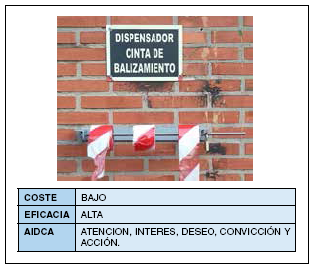
This improvement is low cost and has great preventive impact, thanks to which all company personnel can signal risks.
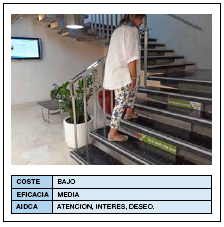
Campaigns in rest or non-production areas
We will use stairs, dining tables, glasses to include short preventive messages. It has been proven that during these times of rest or less activity the brain assimilates messages more efficiently and lastingly. Below we find an example of the stairs from the National Institute of Safety and Health at Work (INSST):
From Fraternidad-Muprespa, aligning ourselves with the Vision Zero campaign, we advise our associated companies and propose tools to improve the communication of preventive messages, we believe that effective and open communication is key to improving commitment and therefore, increasing the preventive culture in the companies.