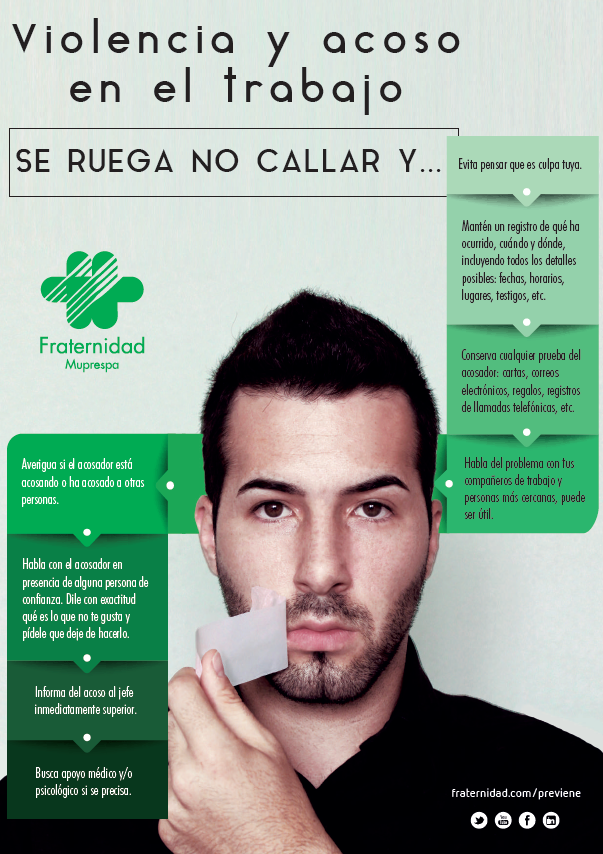

How to develop a protocol on workplace harassment behaviors
This week in Fraternidad-Muprespa we are dedicating our news space to the fight against workplace harassment and today we want to focus on a guide published by the Basque Institute of Safety and Health at Work (OSALAN) in in which the Observatorio Basque Workplace Harassment Observatory has participated, contributing its knowledge and experience, since as we can read in the guide, a certain concern has been detected for some time on the part of employers, workers and their representatives and prevention professionals, about the lack of documents and tools that refer to workplace harassment.
The objective of this protocol is to help companies regulate their intervention in the face of workplace harassment, avoiding the improvisation that is usually caused by a situation as difficult as harassment at work. As we always say, for this protocol to be effective we must have the commitment of the company's management, the communication and information of the workers and the participation of their representatives, so that all actors are aligned to achieve the same objective: the early detection of these psychosocial risks.
We recommend reading the complete guide, where we will find the definition of workplace harassment, the premises of the protocol (commitment of the company, etc...), the legal basis of the protocol and what we find most useful: the phases of the preparation and execution of the protocol that we briefly describe below:
- Preliminary or preliminary phase: describes the different cases in which a harassment protocol can be initiated at work, whether it is due to a complaint or suspicions of harassment. In this phase, precautionary preventive measures can be implemented to stop the problem at its beginning, which is desirable.
- Mediation phase: this important phase aims to resolve the conflict quickly, quickly, through dialogue but in which a person is necessary to act as a mediator between the parties in conflict.
- Resolution phase: this phase begins when any of the parties has rejected the mediation phase and the measures proposed by the mediator, or when the measures have not resolved the conflict, or when the physical or mental state of the affected person makes it advisable not to go to mediation.
Once the procedure is completed, control and monitoring of the resolutions adopted will be established and, as always, a review of the protocol with a reasonable frequency is recommended.
The protocol must have fundamental characteristics such as maintaining certain important guarantees, such as the confidentiality of the complaint, the procedure, the preventive measures adopted as well as the witnesses involved.
From Fraternidad-Muprespa, we want to promote healthy, safe and healthy work environments, in addition to generating responsible thinking in companies and workers, based on the values of thepromotion of health.