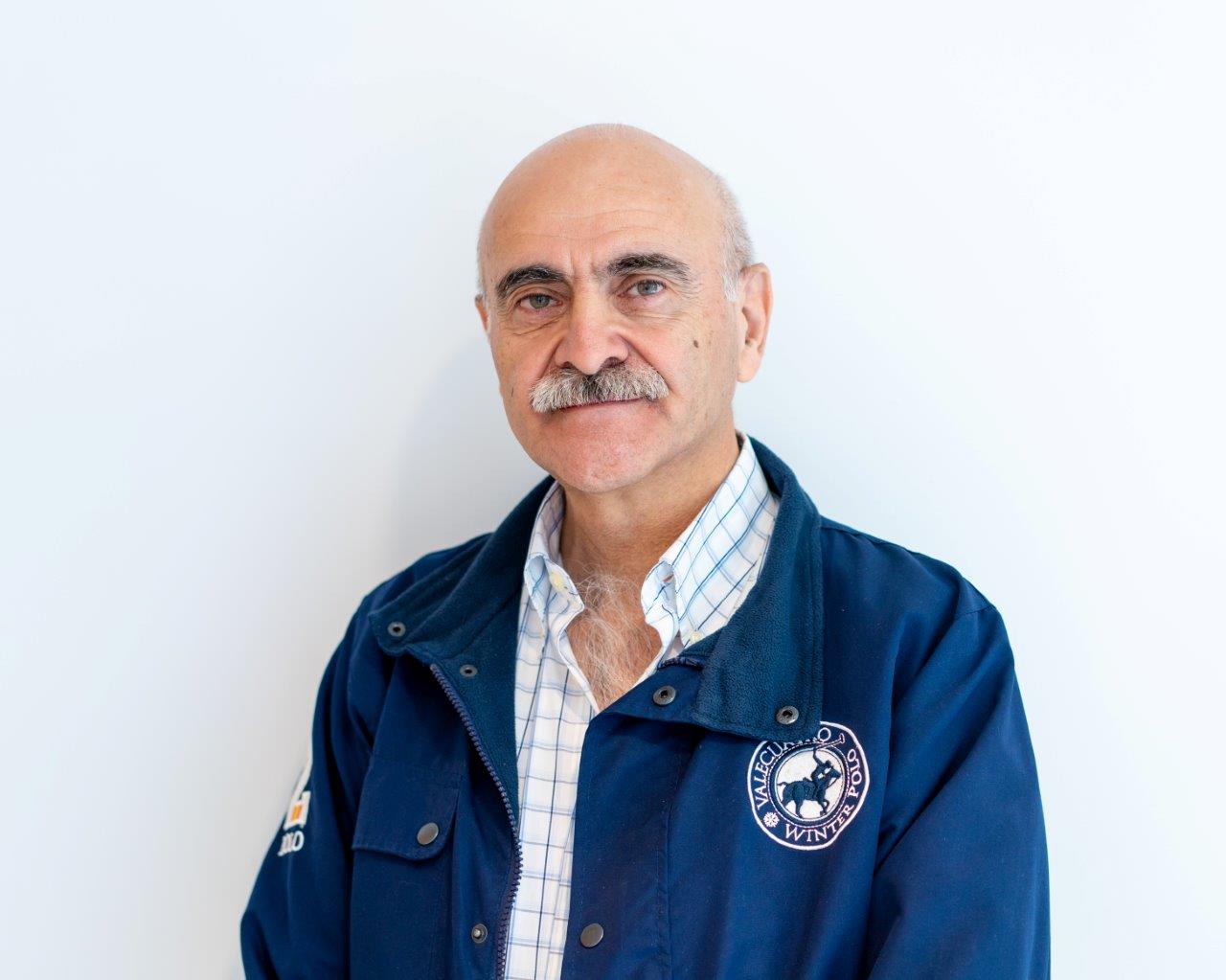
Interview with Juan Pablo Aguado: forty years of experience
Juan Pablo Aguado has been working at
It is common to find him at international conferences learning and teaching new maneuvers that he regularly practices in our Hospital Paniagua.
When a patient enters Juan Pablo's office, the first thing they perceive is the confidence that a great professional is going to care about offering you the best possible solution.
He is one of those members who add value to a team: he has capacity, commitment, leadership and generosity with the rest. For
He is head of the Shoulder unit at the Fraternidad-Muprespa Havana Hospital, graduated in Medicine and Surgery from the Complutense University of Madrid, specialist in Traumatology and Orthopedic Surgery, and has a university master's degree in Medical Body Damage Assessment.
Why did you decide to study medicine?
Well it's been so long now that I barely remember the reason. It was probably a combination of things. I don't have a family history. I was born in a small town in Toledo; My parents were farmers and, when I was 8 years old, they came to Madrid to make a living. I remember that I liked sciences, especially Biology. I also wanted to dedicate myself to a profession to be able to help others, and on the only television at that time they showed us medical series in which everything was very wonderful, rosy and everything always ended well (I remember the ones about Centro Médico and Marcus Welby)
What personal skills do you think a good orthopedic and trauma surgeon should have?
I think he must really like what he does and be constantly questioning his actions. Continuing study and training are also obviously required. An accurate diagnosis of the patient's injuries must be achieved first and thus the appropriate treatment can be indicated in each case. Technical skills can be learned and improved with practice, but attitude, effort and work are what are essential, and this most of the time comes “from the factory”. To progress and learn, we must be humble and objective with our professional performance, being able to recognize where we have something to improve. In the words of Charles Dickens “Every failure teaches a man something he needs to learn”
You have been working at Mutua for 40 years, what does it mean to you?
Well, it is a satisfaction. Carrying out a job for so many years means that it is something that fulfills and pleases you, that you have not made a mistake in choosing your profession and that in the company where you do it you have found a place where you are comfortable, and that you have not done so badly when they have put up with you for so long.
Throughout your career at Fraternidad-Muprespa you have worked in the hospitals of Mutua, Madre de Dios, Paseo de La Habana, Fraternidad-Muprespa Habana. What would you highlight about each stage?
I don't find anything special to highlight about each stage, because although with their peculiarities, all of them have been healthcare medicine in trauma hospitals. In all of them I have tried to do my best for the patients and the company. I have worked with many colleagues from whom I have received help and always tried to learn at each stage, always trying to collaborate.. And after all these stages, I have arrived at the current situation in the new Fraternidad-Muprespa Havana Hospital, which is what matters in the end, and I want to highlight that we currently have a Traumatology Service that is eager to work, with an excellent relationship and with a professional capacity that I believe we have little to envy of other Mutual Funds, although we always look for ways to improve, in order that the treatment of the patients is better and, therefore, the results of the Mutual.
You are a shoulder and elbow specialist. What is the most common pathology?
Rotator cuff injuries. They are age dependent and as the years go by their frequency increases and they affect almost the entire population, as if it were a plague, and in many cases they do not give symptoms, but when they do they can significantly affect the quality of life and work abilities.
How has the treatment of this type of injuries been progressing?
Rehabilitation is a basic treatment for these injuries and surgery is indicated depending on the type of injury and patient, but in general, given that they tend to progress over time, surgical treatment is very common. Before we did it through open surgery, but since the introduction of arthroscopy, they are practically always treated using techniques assisted by arthroscopy.
What type of surgery is the most innovative and the one you use the most?
In our specialty, the evolution and development of new techniques seems to have no end, and requires continuous reading of specialized publications and attendance at courses. Arthroscopic techniques are the ones that we most frequently have to use and also the different forms of osteosynthesis. In order to be effective specialists, one must be in permanent training and master many techniques to be able to apply the necessary ones in each case and patient.
We treat Work Accidents and Occupational Illnesses. Can we talk about prevention in orthopedic surgery and traumatology?
Well, I believe that injuries that depend on performing repetitive movements and continuous handling of tools can be prevented, but this would imply investing in preparing workplaces and using protective elements and more ergonomic tools and machinery, and I don't know if all companies would be willing or have the capacity to do this.
What part of your job is the one that attracts you the most, that you enjoy the most?
Without a doubt, contact with patients. It is also very satisfying when a difficult injury can be fixed, but this is only a technical issue. My greatest satisfaction is a grateful patient. And if you have recovered to resume your normal life and work, it is the best.
When do you plan to retire from your activity as a healthcare professional?
If it were up to me, never, I really like what I do. Well, as long as my health is good, my colleagues put up with me and the Mutual Fund allows me, I plan to be at the foot of the canyon “sine die”.
In a phrase or word define your career in Fraternidad-Muprespa
It is very difficult to define it with something so brief, but they would be the same ones that guide one's behavior in life. As a word it could be “honesty” and I would choose a phrase from Albert Einstein: “Setting an example is not the best way to influence others, it is the only way.”