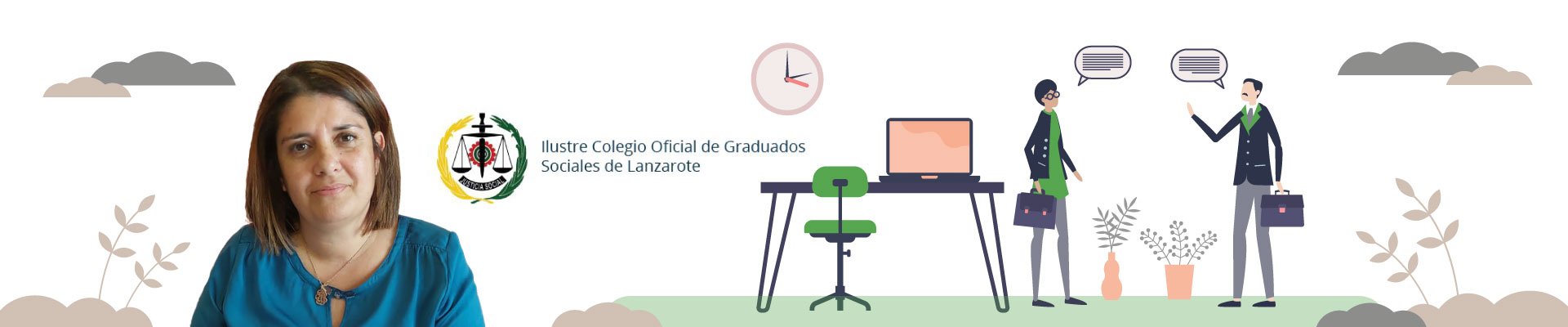
Lourdes Rodríguez, president of the CGS of Lanzarote: "We work with mutual insurance companies to protect clients"
Carmen Lourdes RodríguezShe is the president of the Illustrious Official College of Social Graduates of Lanzarote. In addition, he is the owner of a labor, legal, tax and accounting consultancy firm.
Can you tell us what the fundamental work of a social graduate is?
The social graduate assists in representation before the courts of social order in all those matters that are entrusted to him by companies, workers, pensioners, unions and corporations. It acts before the autonomous administration, processing any relationship with it in social-labor matters, and before organizations and entities dependent on the different ministries in all types of procedures and representation of companies, organizations of any nature and workers, such as the National Institute of Social Security, the General Treasury of Social Security, the Institute for Seniors and Social Services IMSERSO, the Labor Inspection or the Public Employment Service. And without forgetting others such as the state and regional treasury, the Civil Registry or the Government Delegation for immigration issues.
The fundamental work of the social graduate is the advice and management of the majority of SMEs, 80% of companies, in labor and employment matters.social security, accounting and taxes and risk prevention.
How has your task been to support and help workers affected by ERTE or the self-employed who have had to resort to a benefit for cessation of activity or significant reduction in income?
We agreed to be interlocutors for the workers and the SEPE, an organization that was saturated, and we began to process all the documentation so as not to leave the workers helpless. We had to use our imagination so that the workers themselves were informed of the procedures they needed, the law required us to have their signature as evidence on the documentation but they could not leave due to the state of alarm. We use WhatsApp, emails, SMS,... everything to expedite your collection in the shortest possible time. And all despite the difficulty we had in interpreting the law in many cases, since they were published at night and the next day we had to have it integrated to act and sometimes they contradicted each other.
From the first moment, social graduates from all over Spain took the step forward, we understood that we were the ones who were professionally trained for this, having the tools and trained personnel to carry out this work.
It was crazy, but we had the support of our workers and the professional associations of each area and the General Council. In our case in the Canary Islands, the work done by the General Director of Labor was incredible.
Regarding the cessations of activity, we understood that we had to work side by side with the mutual insurance companies to protect our clients and that is what was done. I think it has been a good job among all of us.
Does working in a place that is one of the main national and international tourist destinations affect the entire tourism business fabric of the island, and by extension the rest of the business sector and society in general?
Honestly, the situation in which an island like mine finds itself, where there is no industrial fabric, nor enough agriculture to create an economy, much less livestock, is worrying. Tourism devastated all activities and the primary sector was not protected, we had an island full of closed cement.
We have to reflect together, it is time to create synergies and promote a circular economy that pulls each other because the world is changing.
What has the collaboration of the social graduates with the different levels of the Administration, and specifically with the collaborating mutual societies, consisted of?
It was an almost linear process. First was the management of the ERTES with the provincial labor directorates. This entailed a lot of documentation and in many cases reports from the Labor Inspection and representing the company before these. Once the first step was achieved, we had to send the documentation to the Treasury to manage the quotes and also to the SEPE or the INSS so that the workers continued to be paid.
As for the mutuals, we had to do collaborative work. In a very short time, we were forced to fill out, manage and send data for self-employment terminations, and continue processing sick or accident leave reports.
What demands do you make to the group that you represent, both before the Administration and society in general?
Well, I demand a change in mentality, more training, more support for the General Council and the professional associations of social graduates. But above all a change in aptitude: we have to be aware of the role we have played in this pandemic, we have made a very important engine work, which is the economic one. Thousands of companies have been able to survive while maintaining employment and many workers were able to eat and not go out into the streets, it was epic work, very hard work. We started first thing in the morning and continued until the evening, without weekends, as we were on the front line risking our health and that of our workers and collaborators. Before the Administration I demand greater collaboration, that they understand that we are in the same boat and that we row together without complexes and without fear.
How do current social graduates perceive the future of the profession?
Our profession has a great future. As the Administration digitizes, it makes our professional lives easier, and the C olegio supports all this training and management. The tools that it puts at our disposal are very interesting, for example those that F raternidad-Muprespa facilitated us in the State of Alarm. But I understand that the citizen on the street has to have the knowledge, because if not they are lost, no matter how many digital certificates they have to be able to process.