NTP 1.142: Dotte Method, practical ergomotricity to avoid MSDs in healthcare
Continuing for another month with the campaign started by EU-OSHA: Healthy jobs, let's relax the burdens, we bring to our news today a new prevention technical note published by the National Institute of Safety and Health at Work (INSST) related to musculoskeletal disorders (MSDs) that affect healthcare workers in terms of patient mobilization.
NTP 1.142 Practical ergomotricity in the face of MSDs in healthcare personnel: Dotte method
Patient mobilization can constitute, for some categories of healthcare personnel, a task that can become very difficult, which is why we need tools to be prepared. To this reality of physical workload that is a fundamental part of hospital work, we must add that it is usually added to by pressure in the service, frenetic rhythms that are due to different factors in the organization of work.
The Dotte method is a practical work methodology that can help health professionals in the knowledge of safe and simple techniques for moving the human body.
Objectives pursued:
- Prevent musculoskeletal injuries in healthcare personnel.
- Know the use of basic procedures for safe mobilization.
- Work on ergonomic concepts aimed at guaranteeing safety and comfort, both for the person being cared for and for the professional.
- Acquire non-harmful postural and gestural skills.
The movements and trajectories on which this method is based are based on spontaneous displacement which is defined as:
- Set of gestures and trajectories performed by a healthy person to carry out a movement or change of position more easily.
- Innate movement that is carried out without receiving instructions.
- There are several invariable elements that justify that this reference displacement must be respected to favor movement.
- Integrate increased patient collaboration into an economy of professional effort.
In addition to spontaneous movement, the method delves into ergomotricity by adopting a series of postures and gestures, which, when well executed, constitute a key safety factor.
According to this method there are five defined postures and four gestures, although in patient mobilization the most used are three postures and three gestures:
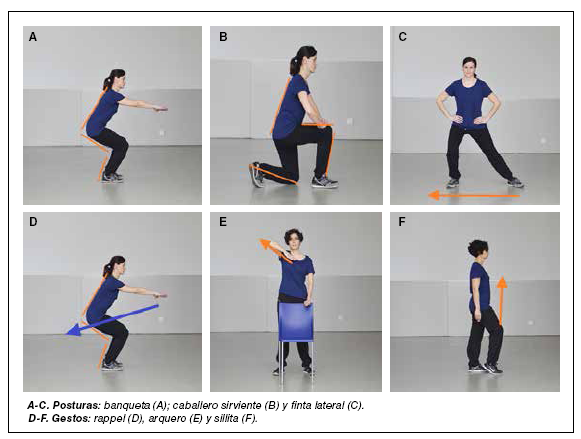
In all of them it is necessary to keep the back straight and the physiological curves so as not to hurt ourselves.
The postures are described as:
- Stool: professional stabilized on the lower extremities, plumb to the width of the pelvis, heels pressed to the ground, back straight and thighs almost horizontal (they can even serve as a support surface). In this position, a large part of the patient's mobilizations are carried out.
- Gentleman Servant: the professional with one knee bent at 90°; the other in contact with the ground, with the tips of the fingers flexed. This position allows you to work on a low plane, such as the ground, in a safe way.
- Lateral feint: in a standing position, back straight, feet separated and well supported on the floor, slightly oriented outwards, with one knee bent and the other stretched. When the action is executed, the position is reversed. The flexed side always corresponds to the load side.This posture is used in all straightening movements, both in bed and in the chair.
- Rappel: from a bench position, transferring the weight backwards using the patient as a counterweight.
- Goalkeeper: diagonal upward pulling gesture, with the elbow flexed and the hand close to the bust.
- Seat: Support action in a standing position, carried out with the thigh of one of the lower extremities semi-flexed and resting on the ground with the tip of the foot.
Thus we see that by training in different postures, we can achieve the reduction and in some cases elimination of the force applied in some weight transfers, thus reducing MSDs. We are aware that the technique is advancing exponentially but there will always be direct physical interventions by healthcare personnel with patients, so we believe that a safe work philosophy is the only way to reduce the effects of MSDs.
At Fraternidad-Muprespa we make our online classroom available to our associated companies with free courses, such as the back workshop. On the other hand, we always try to innovate and from a holistic point of view of prevention we recommend the healthy itinerary Walking towards well-being, where you can find healthy content, as well as videos, routines, workshops, courses, which for free will help you mitigate musculoskeletal disorders as well as promote health in a comprehensive way. Sign up!.