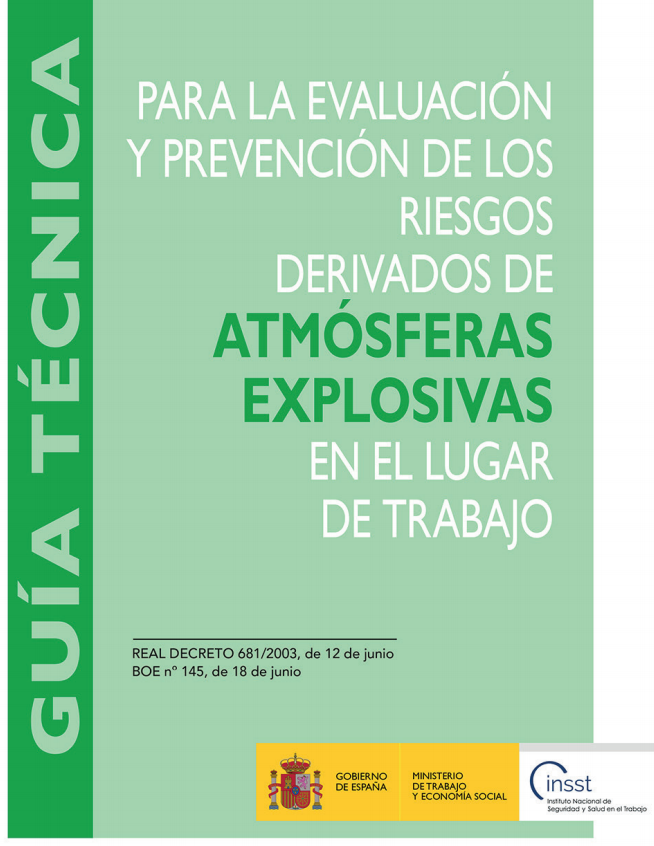

Technical Guide Update on Explosive Atmospheres
On July 20, the National Institute of Safety and Health at Work (INSST), updated the Technical Guide for the evaluation and prevention of risks derived from explosive atmospheres in workplaces. This guide facilitates the application of current legislation, which is the Royal Legislative Decree 681/2003 of June 12, in addition to proposing preventive measures that can be applied in the risk assessments that must be carried out by entrepreneurs and prevention technicians.
The guide has three different parts, the first is the articles that include the final provisions and sections for clarification of concepts, the second part, of a technical nature, addresses the sections corresponding to the annexes to the Royal Decree and the third part describes the sections considered too long or technical to be able to be interspersed.
But, what has been updated? Specifically, as INSST:
tells us- The comments regarding Article 5, the Single Additional Provision and the content of Appendices 4 and 5 have been modified.
- The content of Appendix 1 has been simplified and clarified, which is related to the functions and preventive qualification of each of the figures that appear in the Royal Decree.
We reflect below, part of that second point of simplification that has been clarified, an item that, if it normally seems relevant to us in work with explosive atmospheres, is a priority:
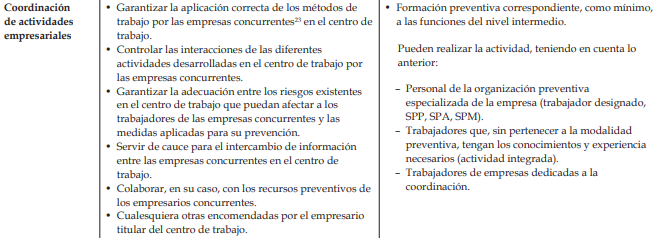
The so-called CAE, Coordination of Business Activities, in this table we see the functions and the minimum required qualification. This CAE should be more effective (if possible) than in environments with less obvious risks, although in this case, the personnel who will carry out the CAE will be very specialized and with years of experience, which is an advantage and a disadvantage, since we will have to refresh good habits so that they do not decline. Well, how can we improve in this very fundamental communication that we need to carry out?...we can read our guides of good preventive practices, prepared in collaboration with Prevencontrol, for example, that of Cultura or that of Emotional Intelligence, PNL or Accident Investigation. All they will give us clues on how to innovate and improve the effective communication that is so necessary.
In these very technical and specialized environments, whose tasks are all critical, is where we should see the importance that we must all be leaders in safety, in ATEX environments, all workers without exception must be committed, since a distraction or error (those that we know will happen no matter what) can have disastrous consequences. Although we have not yet published the Guide to Good Practices in Leadership, this page, one of our favorites, serves as a preview:

Surely we all have in mind some good security leader that we know, but the key question we should ask ourselves: am I a good leader? or what is more important: how can I improve my leadership, inspiring others?...well, you will be able to find the answer to these and other questions when we publish the leadership guide.
Fraternidad-Muprespa, in its desire to reinvent itself, publishes these good practice guides, with the aim of advising and providing tools to our associated companies to diagnose and evaluate their risks, implement measures and improvements, in order to reduce the accident rate, which is our reason for being.