
Guide to Good Practices in Preventive Culture
Within the 15 guides of good practices that we are presenting individually on a monthly basis, prepared in collaboration with Prevencontrol, we find the one that concerns us today: Good Practices in Culture Preventive. One of our favorites, although all of them open the door to excellence in occupational risk prevention, innovation and of course, continuous improvement.
Specifically in this guide we will delve into the nuances of an issue, no matter how difficult it is, the less exciting it is: what is preventive culture? There it is nothing. As we read in our guide:
Safety Culture is the way we do security in our company
to which we add: when no one sees us. That is, we need to find that subjective component that pushes us to commit to safety and health, to lead (without it being necessary to be managers, we must all be leaders in safety), to raise our hand if we see or detect unsafe behavior... Engagement, an Anglo-Saxon word that describes commitment in a superlative way.
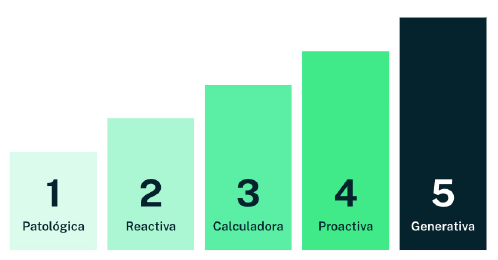
As always in a very clear, concise and simple way, we will tell you the 5 levels of positioning of companies in terms of their preventive culture, we need to know what our starting point is to improve:
There are different diagnostic methods that are described in the guide, interviews, surveys, field visits, small group sessions, etc... any of them will help us measure where we are.
Once the diagnosis phase has been completed, the company's management will have to visualize where it wants to go in terms of security and why. Of course, deciding and detailing the company's strategy is one of the most important and at the same time most fascinating tasks of an organization, it is when we determine where we want to go.
Throughout the guide, both in the diagnosis phase, as well as in the phase of the management vision proposal, as well as in the description of the integration of culture, as well as in the involvement of people, as well as in the final phase of review of the objectives (we do not lose sight of the Deming cycle PLAN+DO+CHECK+ACT), we will see good practices of successful companies that will serve as an example and that we can implement whatever the sector or size of the company.
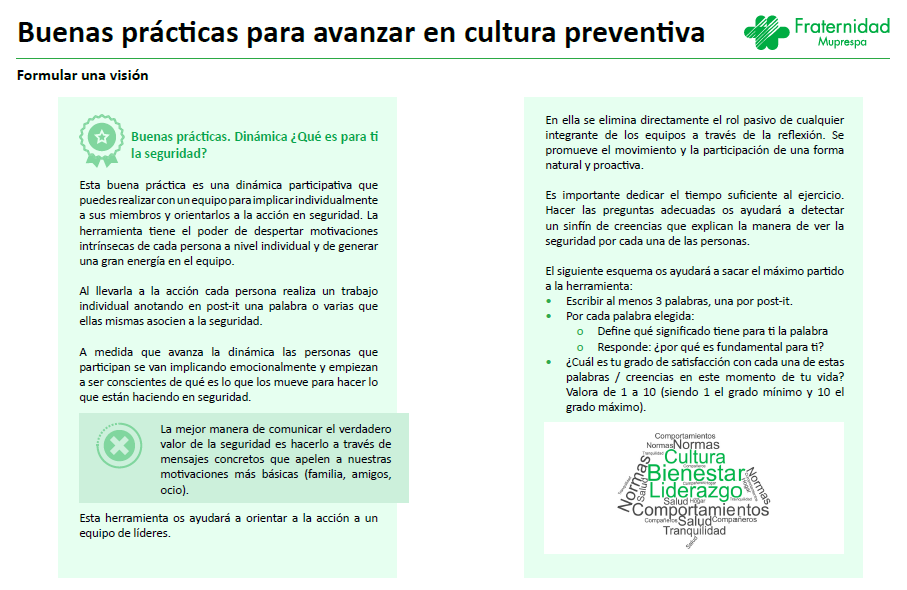
We don't want to reveal more about this fantastic guide, but we do want to show you here one of the practices that we find most useful, in prevention and in life in general:
All our guides have the same structure:
- A brief introduction where the guide is put into place.
- A presentation and objectives section that reflects what is intended with this guide and the target audience.
- Central part with the different chapters, within which practical and accessible content will be included for all people who follow the guide.Each chapter includes:
- Introduction.
- Summary associated with the chapter.
- Conclusions.
- Final reflection questions.
- Solutions.
- Final section with bibliography.
If you aremutualist of our entity and want to know more about this topic, you can read these guides in full by accessing our platform online ClassroomHTMLTAG64___ Prevention which you can access from our portal Previene.
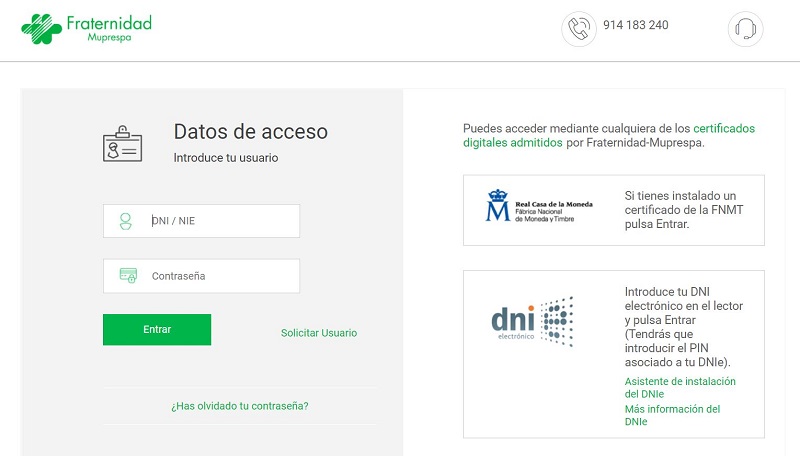
You can easily register and access with your ID and password or digital certificate.
At Fraternidad-Muprespa we hope that these guides are of interest to our mutual members, meet their expectations by predominating practical cases and help to strengthen the necessary preventive knowledge, as well as the implementation of preventive measures that can be effectively transferred to the workplace, thus guaranteeing the safety, health and well-being of employees. workers.
This year, we also celebrate our sixth edition of Prevention Week in Fraternidad-Muprespa, with the motto: “In the face of workplace accidents, open your eyes. ACTIVATE VISION ZERO”, in which we will try to achieve our goal of giving learn about another way of approaching prevention, more effective and that improves the competitiveness and productivity of the company. This new form of prevention will generate responsible thinking in mutual companies, based on the values of promoting the health of their workers, promoting a change in attitudes and consequently improving safety behavior. That is, promoting a culture of safety.
Learn more about the VI Prevention Week of Fraternidad-Muprespa by clicking HERE.