Report from the Digital-Labor Wellbeing Observatory: 80% dedicate 75% of their day to digital tasks
The Digital-Labor Wellbeing Observatory, promoted by
The study, based on a survey of 565 professionals from more than 400 companies, and on two focus groups with prevention experts and occupational health managers, offers a complete x-ray of digital habits at work and their consequences.
Hyperconnection and risks psychosocial
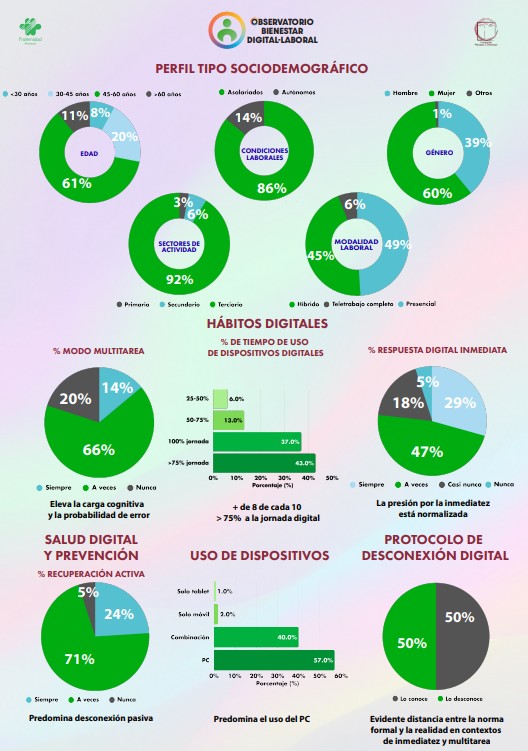
The report from the Digital-Labor Wellbeing Observatory reveals a reality marked by hyperconnection and the constant pressure of immediacy. More than eight out of ten professionals dedicate at least 75% of their day to digital tasks, which reflects a very high technological load and an almost absolute dependence on screens.
The people surveyed report that, in today's work culture, responding quickly has become the norm: three out of four workers acknowledge feeling pressure to respond to messages and emails immediately, even outside of working hours, which makes it difficult to keep the boundaries between personal and professional life.
Multitasking appears as another dominant trait: 80% of those surveyed admit that they perform several functions simultaneously. According to the conclusions of the participants in the focus groups, it is something that “degrades the quality of work, increases mental fatigue and increases the risk of error.” Added to this is the widespread use of informal channels such as work WhatsApp, which makes the work and personal spheres permeable and prolongs the day informally.
In terms of digital health, passive disconnection practices predominate, that is, continuing to consume screens, compared to active recovery through sports, conscious leisure or face-to-face social relationships. Only a quarter of professionals say they consistently maintain active recovery habits. Furthermore, digital training is perceived as insufficient: more than 40% consider the training received to be insufficient.
The study also highlights significant gaps. On the one hand, gender: women report greater exposure to psychosocial risks derived from the double role, work and family, feeling added pressure to demonstrate effectiveness and availability. On the other hand, the generational: while younger workers more firmly defend their personal space and show less tolerance for hyperconnection, older workers maintain habits of continuous availability.
The overload of digital meetings emerges as an additional factor of burnout, and is described as a source of fatigue that affects the cohesion of teams.
Measures strategic strategies for a healthy digital culture
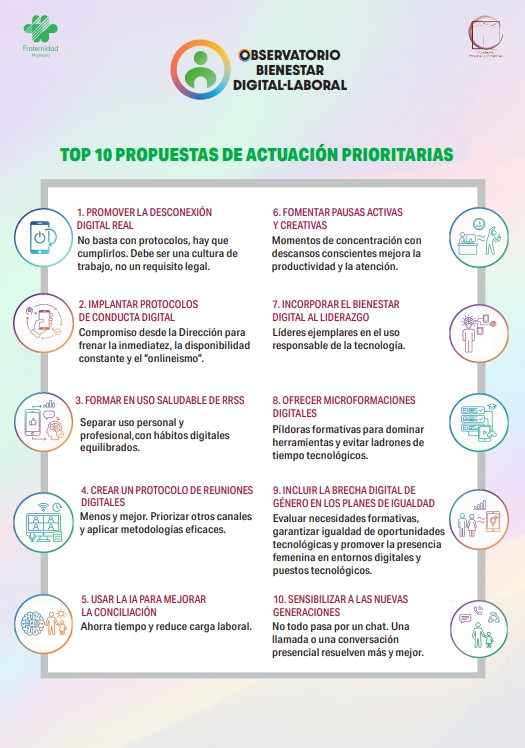
The report highlights that digital well-being does not depend only on written protocols, but on a committed organizational culture. The contradiction between norms and real practices is one of the main challenges detected. The Observatory proposes a set of ten measures that seek to transform the digital work culture.
It is also proposed to create “digital conduct” protocols that especially involve managers, to combat immediacy, constant availability and so-called “onlineism”.It is recommended to train workers in the healthy use of social networks, encourage active and creative breaks that promote concentration, and introduce the dimension of the digital gender gap into equality plans, guaranteeing equal technological opportunities and promoting the female presence in digital environments.
The document also highlights the importance of reviewing the dynamics of digital meetings and proposes incorporating digital well-being in leadership programs so that managers respect meeting times. disconnection.
Interventions
Javier Cantera, president of the People and Business Foundation (AUREN), presented the day, highlighting that digital well-being has become the main component of well-being today, since that technology invades our personal and professional needs. For this reason, he highlighted that "it is not possible to talk about well-being or mental health without considering the digital environment, which acts as a modulating variable of our daily behaviors and conditions the way in which we work, relate and take care of our health."
The institutional opening of the day was carried out by María Jesús Terradillos, director of the Department of Health Promotion and Occupational Epidemiology of the INSST, which pointed out the parallel between the “Study on hyperconnectivity and mental health in the workplace” and the conclusions of the Observatory. "No organization can face the challenge of digital transformation and its impact on mental health alone. The magnitude of the phenomenon of hyperconnectivity requires moving from isolated models towards strategic alliances that allow scientific evidence to be converted into real organizational decisions," he noted.
Next, Laura Gómez Armesto, technician from the INSST Research Department, presented the “Study on hyperconnectivity and mental health in the workplace”, explaining that its main objective was to analyze this phenomenon in depth and its implications on the mental health of working people. To do this, we started from a review of the scientific literature on the matter, from a technical, rigorous and evidence-based approach.
Natalia Fdez. Pérez, director of the People and Companies Foundation (AUREN), presented the results of the report.
Fdez. Laviada explained how digital transformation affects health, performance and the sustainability of work, something that “affects us as a company and also as preventionists.” “In recent years,” he added, “we have incorporated disruptive technology at great speed, such as collaborative platforms, instant messaging, virtual meetings and artificial intelligence, many times without redesigning processes, without redefining times, without training or information and without sufficiently evaluating their impact.” For this reason, he concluded that “digital well-being is no longer just a trend issue, it is key from the prevention of occupational risks”, summarizing the project in eight main headlines.
For his part, Pérez detailed the methodology used to prepare the Report, the profile of the people surveyed (age, gender, working condition, type of work, sector of activity and devices used).They were also asked about their digital habits, their digital load, the pressure for immediacy, the use of work WhatsApp, attention outside of working hours or digital multitasking.
In the field of digital health and prevention, the people surveyed have responded about passive consumption of screens, active recovery, social relationships, their perception of digital training or your knowledge of disconnection protocols.
A second part of the study, as Pérez described, refers to the importance of the focus groups, the synthesis of their results, the final conclusions and the decalogue of proposals for priority action.
Natalia Fdez. Laviada took the floor again to close the day and convey three messages. The first, thanks to the INSST, the experts participating in the study and those attending the presentation. The second, about the importance of not demonizing technology and that digitalization and human care advance at the same pace. And the third, to remember the power of the collaborative force to generate this type of change.
The Secretary General of Fraternidad-Muprespa, Pedro Serrera, was present at the presentation ceremony.