
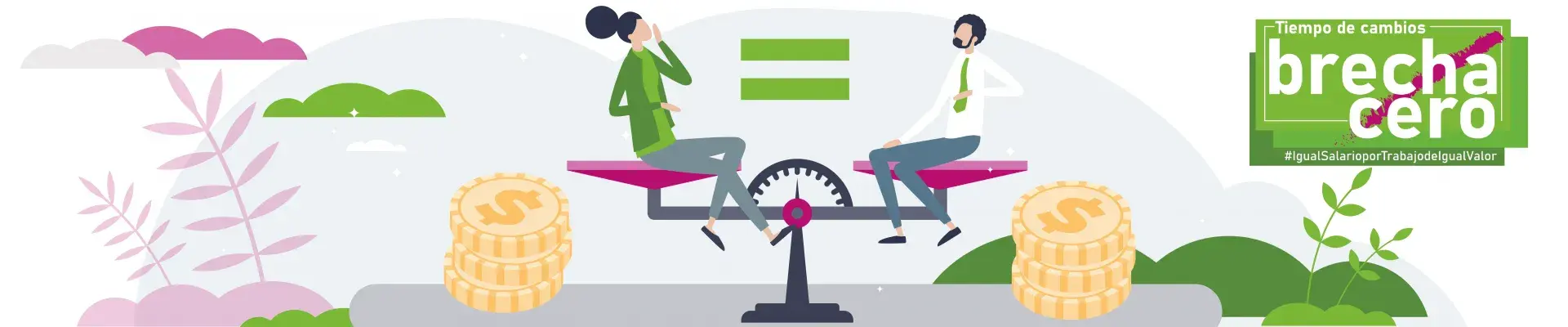
"Time for change. Zero gap" European Equal Pay Day
This is the name of the campaign launched by the Women's Institute to celebrate on February 22 European Equal Pay Day, which seeks to raise awareness about the pay disparity between men and women. Some of the main reasons are labor market segregation, where men and women are represented differently in economic sectors; the particularities of female employment with family responsibilities, the tendency of women to work part-time due to caring for children, dependent adults, and established wage compensation systems. Therefore, this wage gap is influenced by several social, legal and economic factors that represents a concept beyond the principle of equal pay for equal work.
He Women's Institute has the Gender Pay Gap Self-Diagnosis Tool. Besides has launched several initiatives such as race for equal pay; webinars on remuneration transparency instruments; the conference “The impact of Artificial Intelligence on employment and the pay gap between women and men” that faces ethical challenges and gender biases to achieve equality between both genders; or the Equality in Employment Bulletin No. 6 which deals with the concept and calculation of the salary difference, in addition to highlighting the principle of “equal compensation for equivalent work”, established by Royal Decree 902/2020, of October 13, on equal pay between genders, which affects various organizations, regardless of their size, as well as all collective agreements and pacts.
On the other hand, the Annual Salary Structure Survey (EAES) of the INE provided detailed data on this inequality on February 13, revealing that women earn less than men in all aspects of work. For example,in 2021 The most common annual salary for women (14,481.6 euros) represents 74.3% of the most common salary for men (19,487.6 euros). In the median salary and in the gross average this percentage is 81.6%. Besides,The gender pay gap tends to increase with age, reaching its peak in the group of workers aged 55 to 64 years.
To address this inequality, policies are needed that promote equal opportunities, salary transparency and work-life balance. For this reason, Fraternidad-Muprespa carries out initiatives such as IV Equality Plan, v effective from June 1, 2023. This plan consists of 71 actions distributed in 7 axes of application, addressing aspects such as equal pay, work-life balance or organizational culture; and is aligned with SDG 5 of the 2030 Agenda, thus reflecting Fraternidad-Muprespa's continued commitment to gender equality.