
Tangled in the networks
Have we received an invitation from LinkedIn? Do we accept that friend request on Facebook? Does any of our children want to be a youtuber, tiktoker, instagramer?
It is impossible to avoid being surrounded by new applications that connect us beyond physical space. The virtual space has become the new terrain in which to socialize and invest time and resources. Just like we try to be safe and protected when we are on the street... how do we do it when we are within any social network?
These are a series of tips to avoid disappointment:
1) Be careful with the information we upload, let's take a look at what's behind us (literally).
Before uploading a photo, for example, taken at work, we should check that there is nothing that provides confidential or sensitive information.
2) Create our accounts from scratch.
Many internet pages and apps “help” to avoid having to enter all our data through our access codes to our social networks. No matter how easy this form of access may seem, it is much safer to register with a new account, so that if any of our social networks were hacked, criminals would not have access to other services or other apps.
It is advisable to use a different password for each social network, and avoid including personal information: such as a date of birth or the name of a family member. It is also recommended that it be at least 8 characters combining uppercase, lowercase, digits and special characters. It is vital that no one knows our passwords and that they are changed frequently.
3) Use two-step authentication.
This ensures an extra security step for accessing the accounts, which adds to the security provided by the password. When activated, a request will be sent to enter a special security code every time you access a social network from a new device. These security codes can be received via text message to the mobile phone or through an external authenticator application.
4) Control logins.
It is important to never share your login information with others, as well as log out when using a shared or public computer or device.
5) Avoid (as much as possible) the use of plugins.
Some social network interfaces allow us these plugins and extensions, small apps that add functionality and provide us with customization virtues. Be careful with this! Many of these apps ask us to enter our personal data and our passwords so that they can work, making our account much more vulnerable in the entire process.
6) Think before clicking on unwanted links.
It is essential that we treat the links that we receive on our social networks with great caution. By placing the cursor over the link we will observe the address and where it takes us. If we suspect something, we must contact the sender before taking any step that we may regret later..
7) Clean our contacts.
It is advisable to examine the contacts from time to time, identify or disable any strangers or those empty profiles or those that do not have their own content. In the case of contacts that are added to our networks through their telephone number, we must be especially exhaustive and clean them with some frequency; Telephone lines are disconnected and other people take over without us knowing about it .
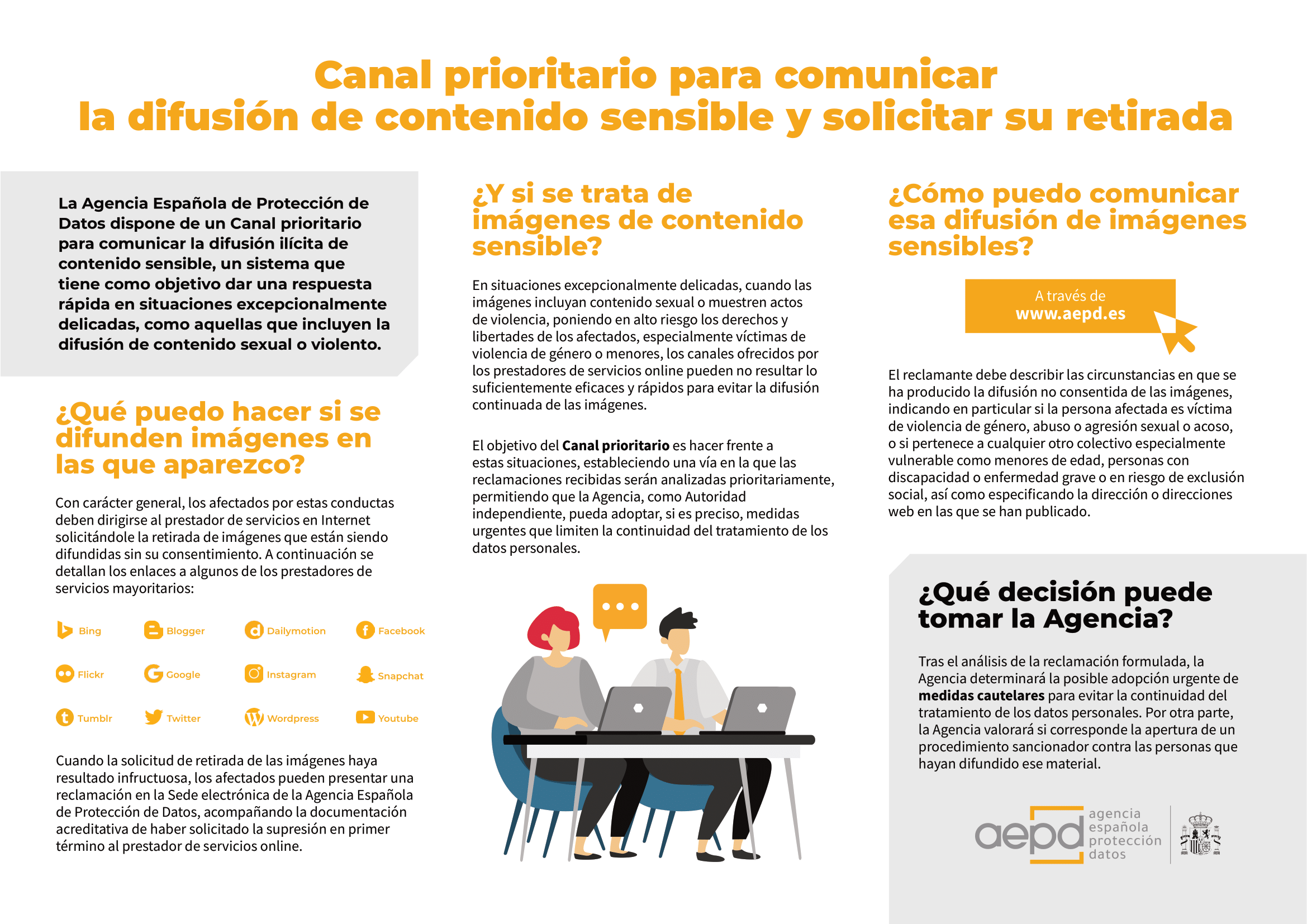
The Spanish Data Protection Agency reminds us of the existence of the #PriorityChannel:
If you are aware of the publication of photographs, videos or audios of sexual or violent content on the Internet without the consent of the affected people (Spanish people or people who are in Spain), request their removal on the Agency's Priority Channel.