
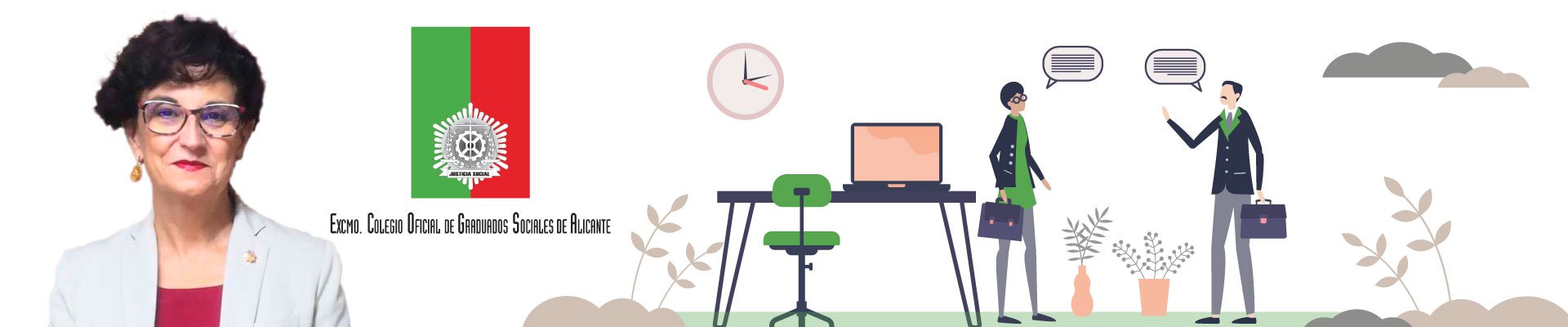
Mª Antonia Oliva, president of the Alicante Social Graduate School: “The profession chose me”
María Antonia Oliva Verdú She has been president of the Valencian Council of Social Graduates and the College of Social Graduates of Alicante since 2016, positions that she combines with the work of social graduate and manager of her own consultancy. We will learn about his professional career and what his beginnings in the profession were like, as well as the work that the College does and the benefit it brings to its members. Gender equality, the reconciliation of work and family life in her profession, the role of communication and social networks, female entrepreneurship and the passion she feels for Villena are other topics discussed by María Antonia, which will allow us to get to know a little more about this excellent professional.
Tell us when and why you chose a liberal profession. What do you remember from the beginning of your business adventure?
I didn't directly choose the liberal profession, it chose me. I started working with a solicitor and I needed to continue studying and I had something nearby that I didn't even know what it was, social graduates. I didn't really know what it was but they recommended it to me and I ended up studying it. I really liked it, and when I finished, I considered leaving my job and starting a consultancy. They hired me in a consulting firm in Ibi, of which I am the current manager.
You currently combine the presidency of the College of Alicante with your work at the head of your consultancy, in which of the two positions do you feel better?
They are very different professions. The work in consultancy is better known and in which you are more established, there are always changes, new publications, collective agreements...
Regarding the College, it is very gratifying to be able to see how you can solve problems, help colleagues and the development of the profession.
I am comfortable in both. At first as president, I didn't know if I was going to be able to move everything forward, but I got used to it and it started to be pleasant, since I saw that my work helped other colleagues, clients, my own company...
We live in a world in which immediacy and audiovisual matters prevail. What importance do you attribute to audiovisual communication in your daily life? And to social networks?
I'm not too active on social media but I would like to dedicate more time to it. I like to receive what comes out, I see that it is very important. Regarding audiovisual communication, with the pandemic we have had to learn to use platforms and I see that we are getting more and more used to it. They are very useful for some functions such as conferences and training, and for others they can create barriers when making decisions due to the lack of proximity in courts or government meetings, for example.
What is the role of the media in issues such as female entrepreneurship, women's access to management positions, or work-life balance, to name a few?
I think that in these issues it is important for women to see that there are other women who are in these positions and who can do it. Because of my age and time, I have been the first in many things, for example, I have been the first woman to be president of the College of Social Graduates of Alicante.
It is important that the media can give visibility to those people who have reached the top, and show that if a woman arrives, why can't the others arrive?
And since we're talking about these topics, what weight does female entrepreneurship have in your sector? Is it possible to reconcile? Do social graduates access management positions?
It is a sector where there are many women who are working as social graduates, there are more and more presidents, secretaries, treasurers... There are other sectors where female entrepreneurship is more complicated, but in this one, a lot is happening. For example, in universities they always say that there are more women than men.
Conciliation is quite complicated because it requires having an amount of time that we do not have. We are slaves to deadlines. In this profession, there are many deadlines to meet every month. Reconciliation is sometimes complicated.
All women have to prove that we are worth it when men don't have to do it so much.
We have to believe in ourselves what we are worth and that we can do it and we can be there. There are many times that we, as well as organizations, put the ceiling on ourselves, but we have to bet more on ourselves.
For example, I did not set limitations and believed that I could achieve it. For me, equality is not so much thinking that women have access, but rather not having to think about whether the person in a certain position is a man or a woman.
Finally, we have talked about audiovisual communication, and we know that you are not afraid of cameras, especially when it comes to promoting Villena. What is special about Villena?
It has always had an important cultural tradition, such as the Atalaya castle, the Treasury of Villena, the Church of Santiago... It also has a very good atmosphere, the festivals, such as the Moors and Christians, are very important for us, they allow us to interact with all types of people of all ages... Without them, the town would not be the same. In addition, Villena is very open to any visitor who decides to go, find a place where they are. On an economic level, it has agriculture and is betting on the implementation of a dry port.