
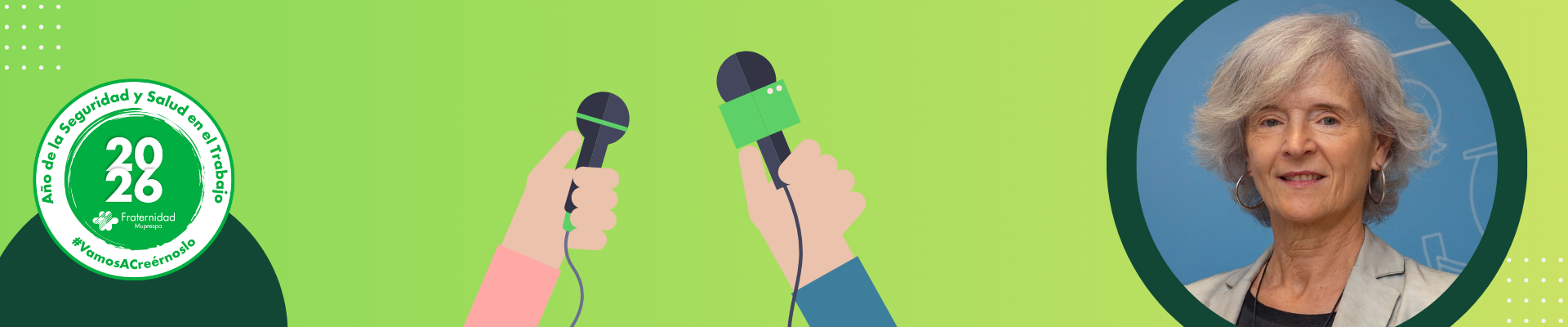
Ana González Pescador: “ICASST is fundamental as a driver of prevention in Cantabria”
Within the framework of the #VamosACreérnoslo campaign, On this occasion we spoke with Ana María González Pescador, doctor in Economics and Business Sciences from the University of Cantabria and current director of the Cantabrian Institute of Safety and Health at Work.
His career combines more than three decades of experience in business creation, university teaching, public management and revitalization of the business community, from the Cantabria Chamber of Commerce to the Santander City Council, where he served as Deputy Mayor.
His vision, marked by strategic management, economic knowledge and proximity to the territory, provides an essential perspective on the present and future challenges of prevention in Cantabria. With it we address how to strengthen collaboration between institutions, companies and mutual societies, how to move towards safer and healthier work environments and how to turn prevention into a shared value that permeates throughout society.
2026 has been declared the Year of Safety and Health at Work. What meaning does this declaration have for your Autonomous Community?
We believe that the declaration is important because it highlights and commemorates the 30th anniversary of the Occupational Risk Prevention Law, which in its day represented a profound change in occupational health and safety in Spain and which throughout these 30 years has allowed for a significant reduction in occupational accidents and the control of occupational diseases.
How do you think the work of mutual societies fits within the preventive system of your community and what improvements or lines of work do you think could be introduced to improve the preventive culture of our mutual members?
Mutual insurance companies are a fundamental agent in the prevention and care of workplace accidents. They have a great technical experience and practical knowledge of occupational health in our country. The reason is that they have direct, real knowledge of workplace accidents, they have the capacity to assist and they are also in permanent relationship with companies.
Mutual societies are called to play an increasingly relevant role as proximity agents in prevention
At ICASST we work with mutual insurance companies in coordination with companies and worker representatives. It is a methodology that we believe can contribute decisively to consolidating in Cantabria a modern, participatory preventive culture, oriented to the new challenges that we must all face and have their decalogue in the Cantabrian Occupational Health and Safety Strategy 2023-2028.
What do you think is the current moment of preventive culture in Cantabria?
The preventive culture in Cantabria has experienced a positive evolution in recent years, there is a growing awareness of companies, workers and institutions about the importance of safety and health at work.
However, relevant challenges continue to exist, especially in small and medium-sized companies, in the face of new risks related to mental health, digitalization, the aging of the working population and climate change.
In this sense I want to highlight the initiatives promoted by the Cantabrian Institute for Safety and Health at Work (ICASST) to bring prevention closer to the entire society in our region. A notable example has been the exhibition on preventive culture installed on the Paseo Marítimo de Santander in the first half of July, organized in collaboration with the Cantabria Construction Labor Foundation, which has taken prevention to the streets, helping to disseminate preventive values, raising awareness about occupational risks and the importance of working safely.
The RESCAN Network represents a modern model to promote preventive culture
Along with the dissemination, training and dissemination actions of the ICASST, I also want to highlight the launch of the RESCAN Network (Network of Healthy Companies of Cantabria), a strategic initiative promoted by the ICASST that constitutes a space for collaboration, exchange of experiences and dissemination of good practices between organizations committed to occupational health and safety. The network represents a modern model for promoting preventive culture, based on cooperation, shared learning and the active participation of companies, entities and professionals.
The combination of public awareness actions, such as the Paseo Marítimo exhibition, and collaborative projects such as RESCAN reflects an advanced vision of prevention: prevention that is not limited to regulatory compliance, but seeks to integrate into organizational culture and social awareness.
In this sense, ICASST plays a fundamental role as a driver of prevention in Cantabria, promoting training, dissemination, innovation and collaboration between all the agents involved.
Thanks to this work, Cantabria is moving towards a model in which occupational health and safety are understood not only as a legal obligation, but as a shared social value, essential to improve the quality of employment, the well-being of workers and the competitiveness of companies.