Fraternidad-Muprespa participates in a conference on preventive culture of the CPRL of Málaga
Progress in preventive matters requires the creation of an organizational culture in occupational risk prevention, since helping to implement this improvement will result in the optimization of business management and, therefore, in the overall results of the company.
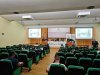
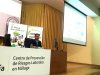
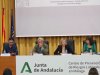
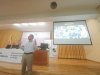
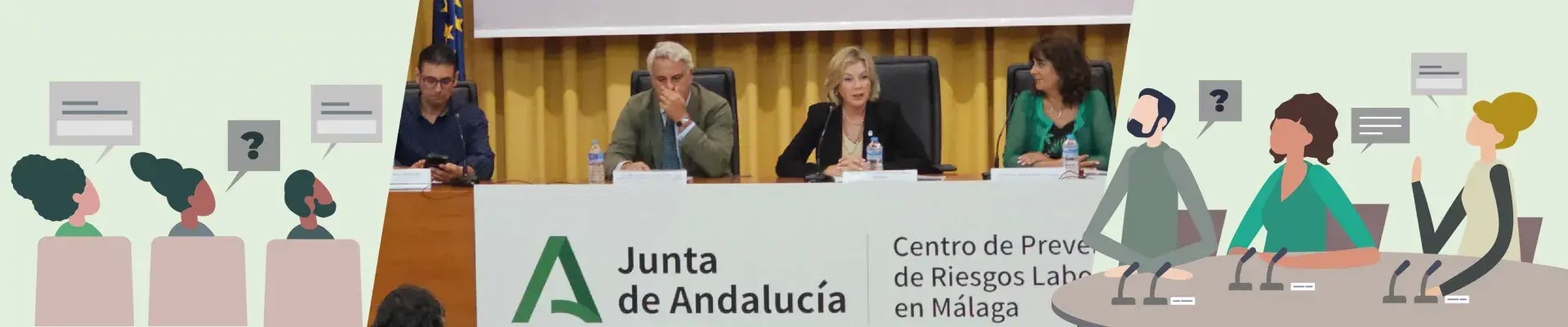
With this premise, the Occupational Risk Prevention Center of Malaga held on Thursday, September 26, the conference “Preventive culture: models and practical cases of implementation, change and improvement”, which was attended by important voices in the field of risk prevention and with the testimonies of representatives of important companies, who recounted their practical experiences to more than a hundred attendees.
The day opened Maria del Carmen Sanchez, Territorial delegate of Employment, Business and Self-Employment, thanking this type of very necessary sessions since any carelessness can have fatal consequences, pointing out that 21%of the work accidents e that take place in Andalusia happen in the province of Málaga, and “we must all continue to influence and work to avoid them.”
Natalia Fdez. Laviada, subdi General Rector of Prevention, Quality and Communication of Fraternidad-Muprespa began by reflecting on whether it is good to work, since work is not just a job. A “good job” exists when the attitude and purpose of the worker is aligned with the business purpose, and this is only achieved in companies with a healthy corporate culture of well-being.
“If the corporate culture is not good, it is changed,” he added. “This requires wanting to change, knowing how to change and having the opportunity to make those changes, banishing limiting beliefs, cultivating self-esteem, awakening the need, and offering tools and knowledge to achieve it, of course, with time and patience.”.
The interventions of Alvaro Suarez-Guanes, Corporate Manager of the Inprex Group and member of the Board of Directors of ANEPA, and José Antonio Vílchez, head of the CPRL Training Area in Malaga, gave way to the master conference "Preventive culture. How it is created, how it works", by Ismael Sánchez-Herrera, president of AEPSAL, who explained, among many other ideas, that “the prevention of occupational risks is closely linked to productivity in companies” and therefore, represents an added value that must be incorporated into organizations.
In the interesting table of practical experiences of implementation and improvement of the preventive culture,Manuel Romero, director of SSL and Organizational Wellbeing at Navantia;Maribel Hermoso, Senior SyS Manager and M.A. at Caterpillar;Fernando Alejandre, PRL manager at Alvic Group; and Carolina Lopez, from Rocla Restauración, a McDonald's franchise in Malaga.
Some of the ideas they shared were the importance of continuous training, the purpose of retaining external clients by pampering the internal client or the search for volunteer leaders in the different departments of a company to raise awareness based on consensus.
Carlos Maya, coordinator of the General Subdirectorate of Prevention, Quality and Communication of
He also described some obstacles to the effective implementation of said culture. "There is no worse company than the one that is comfortable with the current preventive culture. They suffer from 'organizational blindness': they do not see up close (farsightedness), nor from a distance (myopia), nor do they focus well (astigmatism) on their preventive model." He also described as 'preventive Diogenes syndrome' the attitude that prevents the development of a preventive culture, "something that happens when we focus on recording in writing what is done instead of focusing on what is actually done."
Javier Cassini, director and chief auditor at Prevycontrol, intervened last, offering good practices collected in his book "Preventive culture: an influence model for behavior in occupational health", Cassini assured that "there is more culture of prevention than we think" to add that "communication is essential, both for creating two-way channels and for clear information to reach all levels. His intervention preceded a colloquium between attendees and speakers, after which the day was closed.