
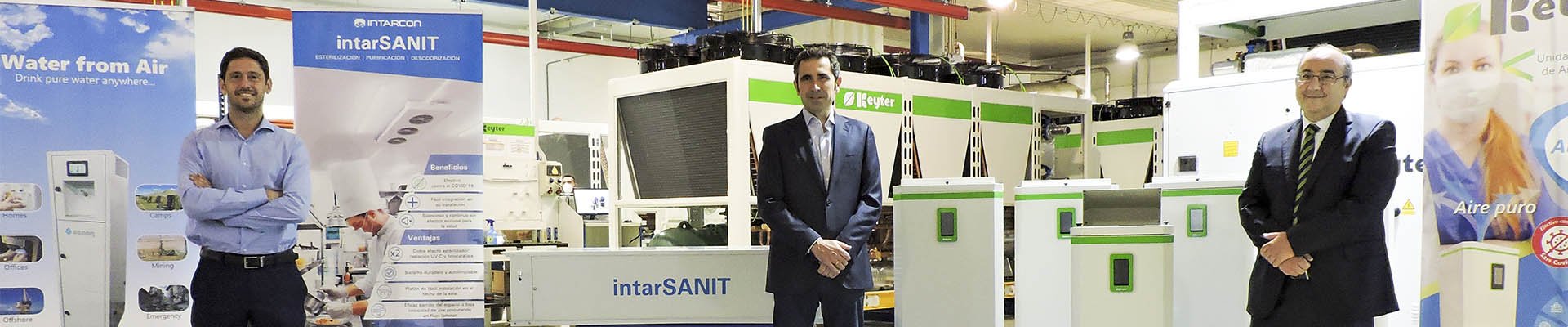
Interview with Antonio Blanco, general director of KEYTER
The cold sector is one of those that is acquiring the most prominence in recent times. Society has been aware of its importance because several of the covid vaccines require freezing temperatures for their conservation and during transportation. There is a town in Spain where talking about cold is talking about business success. We are talking, although it may seem like a contradiction, about the Córdoba town of Lucena, the business epicenter of industrial cold in our country. Antonio Blanco is the general director of KEYTER, a company with 100% Spanish capital, more than 400 employees and branches in Spain and countries in Europe, America and Africa. He details why the cold sector is a strategic sector.
We talk with Antonio Blanco, general director of KEYTER
What is industrial cold and why is it important to the point of being practically a strategic sector?
Within the field of air conditioning and refrigeration, we find two divisions: the technological sector of air conditioning and air treatment, and the technological sector of industrial cold. The latter is responsible for the production and maintenance of facilities used for the production of low-temperature liquids and for the maintenance of spaces and enclosures at low temperatures. When we talk about low temperatures we are referring to temperatures below the normal environmental averages, which can range from the production of cold water between 5ºC and 10ºC in summer for use with air conditioners or -20ºC for freezing applications of food products, to values well below zero, for example, -80ºC. It is a transversal sector whose importance lies in the use of cold applications in practically all sectors of activity, both productive and services, which makes it a strategic sector.
What sectors are the final recipients of your work?
Air conditioning and refrigeration covers a huge range of sectors, from HORECA (Hospitality, Restaurants and Catering) and the food production and preservation sector, such as processing centers, markets, warehouses, slaughterhouses, etc., to production centers for equipment and manufacturing of all types, such as plastics and polymers, paints, chemicals, and the air conditioning of buildings, in the healthcare and hospital, hotel, office, education, renewable energy, pharmaceutical storage, laboratories, etc.
In addition to the above, one of the star applications is the atmospheric generation of drinking water, produced by the GENAQ company belonging to our industrial group and which is present in the emergency, military, mining, off-shore and oil extraction, pharmacy, agriculture, etc. sectors. For all these reasons, we practically have a presence in all sectors.
What can they contribute to the pharmaceutical sector in order to distribute vaccines that may require low temperatures?
Our group has been developing solutions to combat the current pandemic in two lines of action: that of air purification, through Airsanit technology to condition health spaces and reduce the load of bacteria and viruses, and that of refrigerated storage of vaccines, through Cryoblock technology, thanks to the fact that we have the technology that allows us to store any type of product at very low temperatures, around -80ºC, as would be necessary in the case of some of the vaccines that have been developed for the present.pandemic or for other diseases of viral origin that have existed for a long time. Specifically, Cryoblock equipment, developed by another of the companies in our industrial group, INTARCON, allows vaccines to be stored up to -80ºC using ecological refrigerants such as R170. This technology makes it possible to facilitate and ensure the logistical distribution of vaccines in the different territories of application for the enormous existing population, a technological challenge that we will undoubtedly overcome at the beginning of next year.
What investments or adaptations would have to be made to create the material necessary to transport the vaccine?
There are three points that must be adapted: large refrigerated warehouses, long-distance transport vehicles (sea or land) and small refrigerators located at vaccination points. Vaccines can actually be transported in small quantities and short distances using existing means for transporting different medical and pharmaceutical products, since in appropriate containers with adequate thermal insulation and currently existing refrigerated transport vehicles, delivery operations can be carried out from warehouses to the point of use.
The adaptations that must be made relate more to storage warehouses for large quantities, since it will be necessary to distribute refrigerated warehouses in some strategic locations in the territory where these large volumes are kept, as well as the adaptation of large refrigerated containers (maritime or road transport type) to be able to transport these vaccines over long distances, for which we are working with companies that build refrigerated transport systems. Likewise, it is necessary to place ultra-low temperature refrigerators at the points of use that allow the vaccines to be dispensed to be maintained for several days in order to be able to carry out the treatment between deliveries of material from the centralized storage points.
Have you established any contact with these companies, or these companies with you, to guarantee distribution in different nearby geographic areas?
Yes, since the announcement of the authorization of the vaccines that required extreme cold to date, we have received requests from different countries and throughout the national territory, both from public organizations and private companies, interested in these products. Even so, we hope that, given the urgency and need, the information on the availability of this technology will reach all the points where it will be needed so that, shortly, they will contact us. Our production capacity can actually accommodate some more orders in the coming weeks and we even plan to increase production capacity to absorb the peaks in demand that arise from the current pandemic.
What are the main occupational risks that must be prevented in your factories and in your facilities in general?
The refrigeration industry is relatively safe and most hazards are common to many work situations, rather than specific to refrigeration. Although, as in any industrial activity, it is very important to prevent risks and maintain work safety conditions at their highest standard, because accidents, although rare, can be dangerous. The main risks are falls from a different level, falls at the same level and slips, injuries caused during crane lifting or transport, entrapment by mechanical parts or structures, blows caused by moving parts or overhead cranes, injuries caused by container explosions, burns caused by thermal oils or leaking gases or asphyxiation due to breathing refrigerant gases. All these risks must be evaluated and prevented.
His company is an important economic engine in the region. They employ about 400 people and hundreds more may arrive with the planned expansion of their facilities.
This is indeed the case and we believe that the investments, both in new facilities and in research and development of new solutions, will create more jobs in the coming years. In fact, we understand that the current situation has brought to light a concern in the general public about indoor air quality issues that we believe is here to stay. And not only this issue but also because of climate change and the concern to better use water, energy, food, etc. resources. There has been a very strong interest among users in knowing the situation of their facilities in these aspects, as well as knowing the new technologies available that can improve the performance of the facilities in the future. For us, this renewed interest is very interesting and an incentive for the future R&D developments that we were proposing for the coming years, in addition to underlining the purpose of KEYTER as company which is linked to the improvement of people's living conditions. For all of the above, we think that we will continue to generate quality employment in the future.
Although it may seem contradictory, the town of Lucena is an epicenter of this sector, in such a way that even the city council has recently congratulated them for their ability to respond to the COVID health emergency, right?
Indeed, and we are very grateful to the Lucena city council for its effort and unconditional support from all areas, especially in training and investment support. Andalusia is a region in which refrigeration stands as the second private economic sector, after the aeronautical sector, which makes it a regional benchmark. Specifically, in Lucena, practically half of the refrigeration equipment in Spain is produced, even reaching 75% of national production in the case of commercial refrigeration, aimed at the Horeca (Hospitality, Restaurant and Catering) sector. This fact has its origins in very old companies that were pioneers in this sector. Although its continuity, persistence and current expansion responds to the unique character of the Lucencia business community that has been able to accompany its investments and development to the changes of times, to satisfactorily resolve successive generational changes, to create new startups and spin-offs that have originated new lines of business, as well as to involve its management teams and workers in the projects, and to a commitment to internationalization that is difficult to compare in other parts of Andalusia. For this reason, we are talking about a technologically leading sector, with good social cohesion and a great future ahead.
Brief description of the group
KEYTER INTARCON GENAQ is an industrial group at the forefront of technology, with 100% Spanish capital, which was born in 2007 from an initiative of businessmen and professionals from the world of commercial and industrial air conditioning and refrigeration with more than 30 years of experience in the sector. Last year 2019, the group achieved a turnover of close to 40 million euros, which it will exceed in 2020. This growth has translated into productive development that directly employs more than 400 workers, 25% of whom have highly qualified profiles: technicians, engineers, programmers, developers. Currently, the group achieves more than 50% of its turnover in international markets, specifically in countries in Europe, North Africa, the Middle East and America. The group is the leading global manufacturer in some sectors in which it is present.