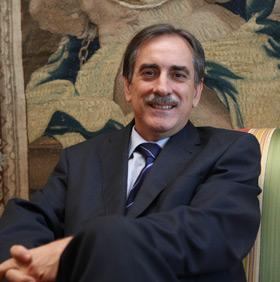

INTERVIEW WITH VALERIANO GÓMEZ, MINISTER OF LABOR AND IMMIGRATION
INTERVIEW| VALERIANO GÓMEZ
The Minister of Labor and Immigration, Valeriano Gómez (Arroyo del Ojanco, Jaén, 1957), has been kind enough to grant Fraternidad-Muprespa an interview in which we have had the opportunity to discuss with him the issues that most concern and interest our sector.
We have analyzed topics such as new technologies and the benefits that they can bring to the citizen, the possibility of preparing a “white paper” on the M.A.T.E.P.S.S in which all the agents involved in their mission participate or the need to clearly identify the concepts of absenteeism and sick leave due to common contingencies.
Minister of Labor and Immigration
Madrid, October 2011.
Fraternidad-Muprespa (F-M). We are aware of the enormous effort that the General State Administration, and specifically Social Security, has made in serving citizens through new technologies, complying with Law 11/2007 on Electronic Access for Citizens. We highlight the success of the redtrabaj@ portal of the State Public Employment Service, which allows the automatic application and granting of benefits. However, it has not achieved the objective of becoming a “job portal” as it intended, nor arousing the interest of employers and job seekers.Does the Ministry intend to work along these lines, to offer a quality job search service through the Internet to companies and job seekers?
VALERIANO GÓMEZ (V.G.). From the Ministry, we want the Internet to be a channel that facilitates workers and entrepreneurs with all the procedures they have to carry out in our field of action and, fundamentally, that it can constitute a way to know and find job offers through the Public Employment Services. In this sense, we have made a lot of progress regarding the processing of unemployment benefits online, as well as in the attention in the offices themselves in the recognition of benefits thanks to the launch of the Online Appointment service, which has prevented unemployed people from unnecessary waiting, waiting in lines, in addition to improving the work environment for the officials themselves.
On the other hand, within the Spanish Employment Strategy 2012-2014, we want to give a boost to everything related to job search through the Internet and, therefore, commit to extending the use of electronic Administration in the National Employment System.
This involves providing digital accessibility to people and companies that use employment services so that they can access both the completion of procedures and the provision of services. This will entail the creation of a web space shared by all members of the National Employment System to provide via the Internet information and professional guidance, information on job demand, resources for searching for employment or services and training offers, as well as job offers.
F-M. One of the electronic services with the greatest demand is the pension calculation simulator, under different scenarios. But it is a program that does not use the full power of the Social Security databases, including work life, which is computerized.Why is this service, of very high interest to citizens, not developed?
V.G. Through the Social Security website, any citizen can download a program for free on their personal computer that allows them to self-calculate their retirement pension. The application is easy to use and does not require a digital certificate; it works and responds based on the information that the citizen enters. The objective is to provide citizens with an alternative that allows them to simulate any hypothesis regarding their future Social Security retirement pension.
For years, Social Security has been using all the power of its corporate databases by automating the management of benefits, making it easier for a retirement pension to be processed and resolved in an average period of seven days. Furthermore, it allows workers who request it - normally when their retirement age is close - to be provided with a purely informative nature, the approximate amount of their retirement pension, according to the information in the Social Security databases.
In 2010 alone, the National Social Security Institute responded to 174,563 requests regarding the estimated calculation of the retirement pension, information that cannot generate rights or obligations regarding Social Security. This volume of information represents 67.49% of the total retirement pensions that Social Security recognized in that year.
In any case, and in accordance with the twenty-sixth additional provision of Law 27/2011, of August 1, on updating, adaptation and modernization of the Social Security system, the provision is established, through the appropriate regulatory development, of providing advance information to workers about their future right to a retirement pension from the age and with the periodicity established.
"It is interesting to stimulate actions with the CCAA through profit sharing"
F-M. Public health spending managed by the Autonomous Communities is the subject of growing concern. On the other hand, and from the Social Security System, the possibility of a significant reduction in spending on temporary disability due to common contingency is confirmed. Although steps have been taken, through agreements, to encourage improved management and results by the Autonomous Communities,Would it make sense to consider “profit sharing” in this matter?
V.G. This idea of sharing benefits is what underlies the signing of agreements with the Autonomous Communities for the control of Temporary Disability, as well as in another series of proposals - with their corresponding legal provision - aimed at the Work Accident Mutual Insurance Companies being able to collaborate with the Health Services in those specialties in which the Mutual Insurance Companies are more efficient and have idle resources such as traumatology, rehabilitation, etc.
This helps to improve the quality of care and also to shorten the processes, which can mean significant savings in Social Security spending on I T benefits. Consequently, I believe that it is intelligent to stimulate these actions through this “sharing of benefits.”
F-M. In the last year, Royal Decree 204/2010 implemented an incentive system (“bonus”) for the reduction of accidents, based on the forecasts of the a. 73 of the General Social Security Law according to its text in force since January 2008.Should the implementation of this incentive be understood as a definitive renunciation of the implementation of the system of bonuses and surcharges of the headings provided for since the entry into force of the Law in 1994 in the Law, and never applied or eliminated?
V.G. The Council of State, in its report on the draft of that decree, understood that the incentives regulated therein constitute, precisely, a way of achieving the reduction in contributions to which the question refers. Likewise, he suggested not forgetting the possibility of considering surcharges in the future. Although at this time it was not considered appropriate, it must be taken into account that the system already has penalization instruments through the surcharge of benefits, the action of the Labor Inspection and the courts. In any case, the suggestion of the Council of State was attended to, recording it in the preamble of the decree itself.
"It may be a good idea to prepare a kind of white paper on the M.A.T.E.P.S.S. with the contributions of all the parties involved"
F-M. The MATEPSS, entities that are part of the social security system of Spain, provide coverage in professional contingencies to more than 95% of employed workers, manage the benefit for common contingencies of more than 60%, as well as a significant part of the self-employed in both contingencies. They also manage benefits for risk of pregnancy and breastfeeding and recently the cessation of activity of the self-employed and serious illness of children. There are different and even conflicting opinions between the CEOE, the unions and the Administration itself on the minimum period of association of companies, the constitution of reserves, the scope of management in matters of absenteeism, the participation of unions in management, etc.Could the time have come to prepare a kind of “white paper” on the MATEPSS that receives contributions from the parties involved, offering a model valid for everyone?V.G. I think it may be a good idea and, in any case, it will be useful for the work to reform the regulatory framework of mutual societies, provided for in additional provision 14 of the recent Law 27/2011, of August 1, on updating, adaptation and modernization of the Social Security system. The period granted to the Government, with the participation of social agents, to fulfill this objective is one year, which, without a doubt, requires preparing the task.
F-M. 60% of companies have common contingencies covered through the MATEPSS, a percentage that accounts for 70% of work absenteeism. However, the process to discharge the worker, which ends with the decision of the Public Health Service, does not offer many tools to mutual companies to control absenteeism or fraud.What mechanisms would the MTIN see as appropriate to improve in this regard? Has the possibility of ceding more powers to the Mutual sector for the control and monitoring of common contingencies been considered, which in turn could help to streamline Public Health Services?
"You cannot simply identify sick leave due to common contingencies with absenteeism. We should start by agreeing on the concepts."
V.G. In order to solve a problem well, it is advisable to start by posing it correctly. Leaves due to common contingencies with absenteeism cannot simply be identified. We should start by agreeing on the concepts, the way to measure them and their comparability.
That said, it is clear that it can be improved and the Government has already presented some documents to the social dialogue table with data analysis and proposals in different directions because I do not believe in simple solutions to complex problems.
Maximum collaboration with the health services in whose direction we are moving will always be convenient. And regarding the expansion of powers, it will be necessary to abide by what is decided between the Government and social partners in the future reform of the regulatory framework of mutual societies. Now, this would be much simpler if the mutual societies managed to gain the trust of the representatives of the personnel protected by them.
"It cannot be claimed that the prevention service for SMEs is a free service charged to fees because it is not a Social Security benefit but rather a direct obligation of the employer."
F-M. The MATEPSS have been pioneers in the prevention of workplace accidents, providing very good results in the fight against accidents. A scenario in which the MATEPSS provided SMEs (1 to 10 workers) with free prevention services charged to fees would be beneficial.How feasible does the Ministry see the implementation of this type of initiatives aimed at helping the company financially and improving its security?
V.G. This Ministry has been especially sensitive in this regard, responding to the concerns of business and union organizations. At the proposal of the Secretary of State for Social Security, various measures to support small businesses were introduced in the Spanish Strategy for Safety and Health at Work 2007-2012, which are already bearing fruit; especially the “online” advice and the simplified processing of the documentation required in matters of prevention, all on a computer platform created for this purpose with resources from the Prevention and Rehabilitation Fund. The very name adopted “Prevention 10” refers to the size of the companies to which it is directed. And without a doubt there is still a long way to go in this matter.
Another thing is that there is an attempt to go back in terms of separating mutual insurance companies from preventive activities that constitute a legal obligation of the employer. The path taken in recent years was imposed by the repeated requirements of the Court of Accounts and the General Intervention of Social Security.
It cannot be claimed that it is a free service charged to contributions because it is not a Social Security benefit but rather a direct obligation of the employer. It is worth remembering that the 1995 Occupational Risk Prevention Law itself, which authorized mutual societies to act as a prevention service for their associated companies, never said that it was as a provision of the system but rather as a private prevention service. Precisely from this public-private mix arose the problem of transferring undue costs to Social Security, which had to be corrected starting in 2005. What made it easier to reach those excesses was the permanence over time of a formula that the preamble of the Prevention Law itself defined as temporary to allow the initial implementation of its provisions.
"Your Mutual - Quality and Service, 365 days a year"