
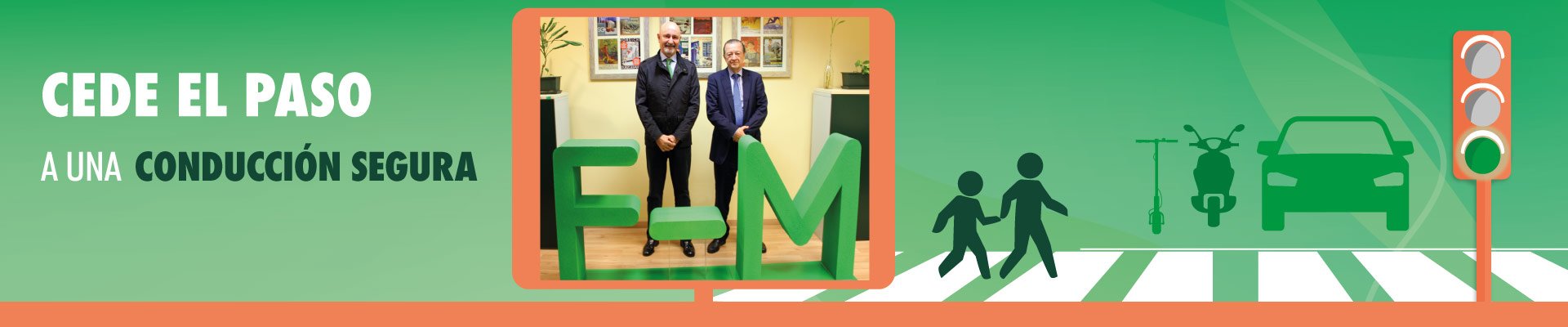
Bartolomé Vargas, first Road Safety Prosecutor, shares his vision on accidents in Fratertalk
Bartolome Vargas, who was the Road Safety Prosecutor of the State Attorney General's Office for 16 years, the first to occupy that position, was the guest last Friday at Fratertalk, the virtual space for debate on the prevention of Fraternidad-Muprespa, held within the framework of V Work Road Safety Week which the Mutua celebrates coinciding with the World Day of Remembrance for Victims of Traffic Accidents, on Sunday, November 20.
With more than 45 years of experience in road safety, Bartolomé Vargas began by describing the Prosecutor's Office he occupied as “an important network” to combat crimes against road safety “with few resources, but a lot of conviction.” “It was of great importance,” he added, “to study these crimes from a scientific, technological, security and criminal law point of view, always in direct and close relationship with all the police forces involved.”
Regarding driving under the influence of alcohol, he explained that "every year there are 50,000 convictions in Spain related to this, one of the highest rates in Europe, but also evidence that there is a lot of penal effectiveness in this regard." To reverse this situation, Vargas advocates prevention and education because “there are more than a thousand people imprisoned for these crimes.”
In his opinion, "surveillance is key. The evidence shows that the more radars are placed on the roads and the more controls are carried out, the fewer road accidents occur." The former prosecutor gave as an example the case of the United Kingdom, one of the countries where the fewest radars are operational and where road accident figures are increasing.
Vargas also emphasized the importance of the medical profession intervening by prohibiting driving for those who take certain medications that They can impair attention while driving. “The law contemplates this possibility, but de facto it is not done,” he explained.
With respect to occupational road safety, Vargas specified that for passenger or freight transportation companies, strict periodic health surveillance checks should be established for their drivers so that, in the event of an accident, there is a record of whether or not the company knew what condition the professional was in. "Otherwise there may be criminal liability for the company. Even if there is a death, the crime of reckless homicide may be charged," he added, going on to explain that "it may be that the consumers, due to the urgency, or the company, due to the commitment to arrive in a specific period of time, are committing a crime."
He also referred to the role of drivers and the evaluation of their skills in the centers where they are carried out. Vargas assured that "a reform is pending to address legislative changes in these centers, undertaking real changes. We have investigated some centers that committed irregularities but progressive efforts must be made in this regard."
Mar Morales, director of the Department of Prevention and Development of Health Culture at Fraternidad-Muprespa, was in charge of closing this Fratertalk after summarizing the most salient points of what the interviewee said.
This is the V Work Road Safety Week by Fraternidad-Muprespa
This is an event organized by the Mutual Collaborator with Social Security on an annual basis with the aim of raising awareness among mutual companies in order to reduce accident rate work road. For this purpose, different events were scheduled this year: a national webinar which featured important expert speakers in different aspects of road safety, four face-to-face sessions, in To Coruña, Zaragoza, Asturias and Murcia, and two face-to-face sessions organized by Regional Institutes for Occupational Risk Prevention, in Jaén and Madrid, in addition to this Fratertalk.