
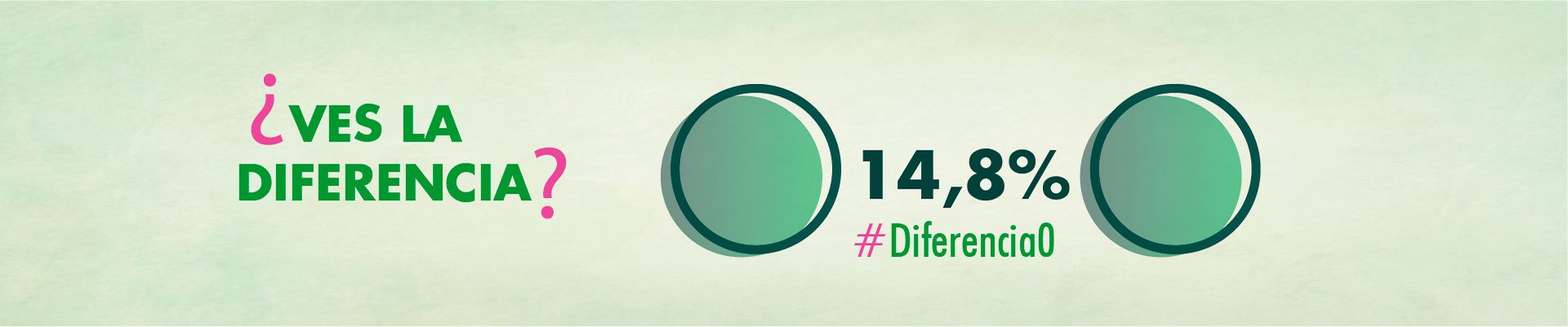
Do you see the difference? Well you shouldn't
Women earn less than men in all sectors of the economy, in all occupations, and even in the same categories and jobs. This resounding and worrying statement does not come from any institution, but from the EU itself. Its Statistical Office, Eurostat, ensures that women receive a salary 15% lower than men. This, in the EU as a whole, but if we take the figure for the countries that belong to the Euro zone, the downward wage difference is close to 16%.
For this reason, and to continue promoting measures to reduce the wage gap and raise awareness about equal pay, Fraternidad-Muprespa is aligned with awareness-raising actions linked to the February 22, Equal Pay Day. These actions are driven by the Women's Institute, more specifically from the Advisory Service for Equality Plans and Measures in Companies, since the differences between the remuneration of men and women for the same jobs are one of the evidence of inequalities in the Spanish labor market.
Under the hashtags #Difference0 y #BreakTheGap Social networks will be flooded with messages on social networks intended to show that we are facing an injustice aggravated by the fact that it is evident what must be done to correct it.
And in Fraternidad-Muprespa, its III Equality Plan maintains and renews the commitment of the Management of the Mutual Fund to equal treatment and opportunities between women and men, beyond compliance with the provisions of Organic Law 3/2007, of March 22.
The economic crisis caused by the Covid-19 pandemic has deepened gender segregation in the labor market. In fact, the European Foundation for the Improvement of Living and Working Conditions(Eurofound) estimated that between April and September of last year, the gender gap in employment increased by 0.4%. This data implies a setback in the levels of equality that had been achieved in the last two decades. The employment gap cost Europe a figure of around 320 billion euros in 2018 alone, which is equivalent to 2.4% of its Gross Domestic Product that year.
For the ILO, the International Labor Organization, the conclusions are similar: the crisis has harmed women more than men. Estimates based on a sample of 28 European countries show that, without subsidies, in the second quarter of last year the wage loss for women would have been 8.1% compared to 5.4% for men.
Companies must therefore be levers of change in this trend that relegates women in general, and female workers in particular, to situations of inequality that also affect all salary and professional levels. The socializing role and commitment of each company is essential to achieve one of the Sustainable Development Goals(SDG) established by the United Nations in its 2030 Agenda, specifically number 5, “Gender Equality” and number 8, “Decent Work and Economic Growth”.