The World Festival of Happiness 2026 opens its doors with the participation of Fraternidad-Muprespa
Business leaders, international experts and representatives of the well-being ecosystem have been attending the World Happiness Festival since Thursday, March 19, an event that, for four days, explores how well-being has become the axis of social and economic progress.
Luis Gallardo, president of the World Happiness Foundation, inaugurated the event structured around different presentations on leadership, new ways of working and the impact of well-being on productivity and business sustainability. For his part, the general director of the World Happiness Foundation,Raul Varela, presented the organization's work on a global scale.
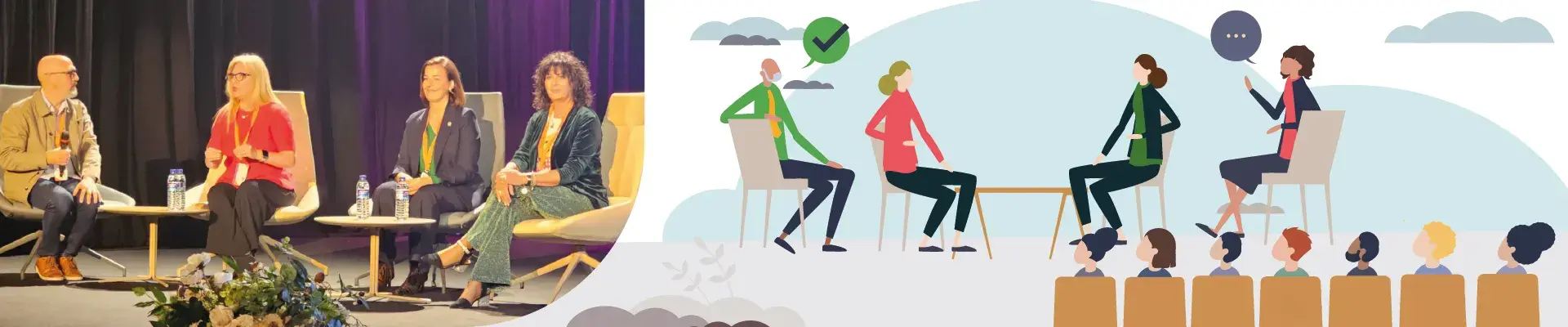
The round table "Redesigning work: well-being and new cultures in organizations" brought together Natalia Fdez. Laviada, Deputy General Director of Prevention, Quality and Communication of Fraternidad-Muprespa,Francisca Garcia, CEO of Hoteles 1800, and Teresa Perez, Wellbeing Manager at Caixabank. He moderated the table Carlos Jordana, known as The Chiel Happiness Officer and creator of the Happyforce platform.
Fdez.
From the perspective of the Mutual Collaborators with Social Security, he pointed out that in addition to focusing on damage management - work accidents, occupational diseases or temporary disability - we have evolved into a comprehensive preventive approach that incorporates mental health, psychosocial risks, healthy habits and digital well-being.
He also stressed that leadership is the true engine of well-being,“a concept that is not built with policies, but in everyday life”. Based on data from the Gallup 2025 report, he highlighted that 70% of a team's commitment depends on the relationship with its boss. In this context, he valued female leadership for its ability to generate trust through empathy, active listening and emotional management, and insisted that the challenge is to move towards more human leadership, regardless of gender.
Other points of his intervention were the need for internal communication, which must be an essential element to build trust and well-being, concepts that are based on three pillars: coherence, transparency and listening, and that often make mistakes such as one-way communication, superficial campaigns, saturation of messages or the tendency to communicate only the positive.
It also addressed the relationship between well-being, absenteeism and occupational health. From the experience of mutual insurance companies, he stated that absenteeism cannot be understood solely as a medical phenomenon, but as an organizational indicator that reflects the work environment, leadership styles and working conditions. Organizations that integrate well-being in a structured way not only reduce absenteeism, but also improve reintegration after long-term absences and strengthen their sustainability.
On the first day, the participation of renowned speakers, such as Víctor Küppers and Julio de la Iglesia, stood out.